
On November 15, 2022, The Church of Jesus Christ of Latter-day Saints issued a statement on the Church Newsroom regarding its official position regarding the US Congress “Respect for Marriage Act” (RFMA).
To provide some context for this statement: the Respect for Marriage Act seeks to require the U.S. federal government recognize the validity of same-sex and interracial marriages in the United States. In the United States, this has been the de-facto status since the US Supreme Court ruled in 2015 that the 14th amendment to the Constitution requires all US States to recognize same-sex marriages1. The RFMA would officially codify this status into law, by making such recognition explicit.
The Church of Jesus Christ of Latter-day Saints has been unequivocal in its position on marriage – specifically holding the position that “marriage between a man and a woman is ordained of God and that the family is central to the Creator’s plan for the eternal destiny of His children.”2
With this in mind, some question why the church would seem to support the RFMA. This post is my attempt to provide some insight into why I think this could be. As always, the views expressed here are NOT the official position of The Church of Jesus Christ of Latter-day Saints, and are based solely on my own understanding and reasoning as a faithful member of The Church of Jesus Christ of Latter-day Saints.
In its opening paragraph, the statement from the Church very clearly says: “The doctrine of The Church of Jesus Christ of Latter-day Saints related to marriage between a man and a woman is well known and will remain unchanged.” As such, it seems clear that the church does not intend its statement regarding the RFMA to indicate a change in doctrine or policy with regard to same-sex marriage.
The Church has been equally clear about following the law. As far back as 1842, when Joseph Smith wrote down the basic tenets that are today known as the Articles of Faith, the Church has had a fundamental doctrinal position of “obeying, honoring, and sustaining the law”.3
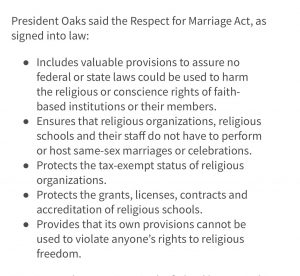
A presentation in November, 2021 from president Dallin H. Oaks of the First Presidency included a reinforcement of this principle, framing it specifically in the context of both law and fairness, especially as they pertain to religious freedom and nondiscrimination. President Oaks stated that “As a practical basis for co-existence, we should accept the reality that we are fellow citizens who need each other. This requires us to accept some laws we dislike, and to live peacefully with some persons whose values differ from our own.” He continued that a basic imperative of this reality is “that we should not seek total dominance for our own position; we should seek fairness for all.”4
I believe that the Church’s position on the RFMA is a practical application of this viewpoint: while the Church doctrine of marriage remains the same, there is room under the law to include fairness for all.
In the United States, our society grants those that enter into the civil contract of marriage with certain rights and privileges not given to those who do not. These rights affect things like medical care: for example, the ability to make decisions for loved ones that may be unable to decide for themselves, or the opportunity to visit with loved ones that may be admitted to a medical institution. The civil laws applicable to marriage also impact rights such as access to medical care through insurance programs, the ability to make decisions for loved ones in the event of death, and access to assets in that circumstance.
The Church recognizes that within the US, civil marriage has been defined to include unions between same-sex individuals. With that understanding, the best course of action, aligning with what President Oaks explained, is to not seek total dominance of having civil marriage redefined to meet the Church’s position, but to instead seek fairness for all. In this case, that fairness needs to meet two needs:
- Ensure that the rights and privileges society grants to those that enter into the civil contract of marriage are protected for all individuals that enter into that contract, including those that have historically been cut off from these privileges. In particular, in the US, this has a primary impact on the LGBTQ+ community.
- Ensure that the rights and privileges for faith-based institutions are not infringed upon by allowing them to continue to define and support the religious ordinance of marriage in the way they choose.
With the religious freedom protections included in the RFMA in its current form, the Church has indicated their belief that the act represents “the way forward”. It’s reasonable to conclude that this position is due to the act working to meet the two needs above, respecting the law and preserving the rights of both sides.
In reflecting on this balance, I couldn’t help but draw a comparison to the principle that Jesus taught in the gospel of Mark. In chapter 12 we read that the Pharisees came to Christ, and asked whether He thought tribute should be paid to Cæsar or not.
When asking the Savior this question, the Pharisees stated that they recognized that Jesus “regardest not the person of men, but teachest the way of God in truth”. In response, Christ asks them whose image is on the coins they pay tribute with. The answer, of course, was Cæsar’s image. Jesus then states the simple principle: “Render to Cæsar the things that are Cæsar’s, and to God the things that are God’s.”5
The position of the Pharisees in these verses seems similar to how some approach the Church’s position on marriage: if the Church seeks to teach the way of God, regardless of the positions held by any “person of men”, then how could it possibly support rights for marriage defined in a way that is different from what we believe God has decreed? For me, the answer is as simple as Christ’s was: we believe in obeying the laws of men. Those laws have decreed that marriage between same-sex individuals is permitted. Therefore, we “render unto [the law], that which is [the law’s]” – in this case, not a tribute of coins, but the protection of the rights and privileges our society gives to those who enter into legal marriage. By protecting the rights of religious institutions to define the ordinance of marriage as they wish, we “render unto God the things that are God’s”.
Returning to the talk that President Oaks gave, he stated that “The goals of both sides are best served by resolving differences through mutual respect, shared understanding, and good faith negotiations. And both must accept and respect the rule of law.” The wording of the Respect for Marriage Act is a good example of balancing the needs both sides have.
As I was writing this, the Senate passed the RFMA with bipartisan support, prompting the President of the United States to issue a statement asking that Congress “quickly send this bill to my desk where I will promptly sign it into law”.6
With this passage of the act, it seems advisable to now heed President Oaks and “accept and respect the rule of law”, and support the fairness that the RFMA seeks to provide. By respecting this fairness, the Church allows for a focus on showing kindness and love to our LGBTQ+ brothers and sisters, while also defending the right to ensure that the ordinance of marriage as performed by the Church aligns with what we believe God has prescribed for that ordinance.
Update (2022-11-28): The Deseret News published an article with additional insight from General Authority Seventy, Elder Jack N. Gerard. That article seems to provide similar reasoning as that presented here, and can be found on the Deseret News Website.
Update (2023-02-11): The Church Newsroom published an article on this, reporting what President Oaks said about it in a meeting for Church leaders in Chicago, Illinois. There were also stories on it in the Church News and the Deseret News.
References
- In the legal case Obergefell v. Hodges
- The Family: A Proclamation To The World
- Articles of Faith 1:12
- Going Forward with Religious Freedom and Nondiscrimination
- Mark 12:13-17
- See: White House Press Statement
 Jason is a neutral good hacker (aka cybersecurity professional) at a Fortune 500 software company, and is adjunct faculty at the Rochester Institute of Technology. He enjoys driving through the mountains and forests, photographing cool abandoned structures with his best friend and wife of 25+ years.
About the Author








Excellent, well-reasoned work!
Oh wow, that’s is exactly what I thought, and you couldn’t have expressed better.
Jason,
Very well written and thank you for raising some important points. There are a few things I still struggle with, however. Interested in your thoughts.
It seems there are (at least) two things to consider here: 1) is the Church’s position on marriage consistent over time? And 2) is the Church’s position on fairness under the law consistent over time? It seems that no matter what, the Church’s stance one at least one of these issues shifted between 2008 and now. It feels like we’re admitting that at least 2) has changed.
Related to that, allowing the Church to soften its position based on the legality of a practice doesn’t seem very morally defensible. A host of morally questionable, but legally protected practices exist, and I would find it equally odd for the Church to sign on in support how they have with this LGBT marriage bill.
Hi JD!
The points you raise for consideration are great ones, and here are my thoughts:
I think the answer in both cases is that Yes, the Church’s position on both marriage and fairness under the law are consistent throughout time. Certainly on the first point, the Church has consistently stated that marriage between men and women is ordained of God.
To the second point, by mentioning 2008, I presume you are referring to the Church’s support in opposition to California Proposition 8. I think the Church is consistent in its support for fairness under the law even though it could appear otherwise, for the following reason:
When Proposition 8 was introduced, it was an effort to create a law to permit same-sex marriage. That means, at the time, the law either did not support such officially, or was unclear. As such, supporting an opposition to the law is not contrary to “fairness under the law”, because the law did not include same-sex marriages.
That has now changed: the Supreme Court has ruled that same-sex marriages are protected. There is a significant difference between supporting the creation of a law to permit same-sex marriage when such is not currently permitted, and recognizing the legality of the same when the highest court in the land has declared that it is protected.
In my mind, proposition 8 fell into the former category, the RFMA comes under the latter.
Regarding the difference between the RFMA and the Church signing on to support other legally protected practices:
It’s easy to mistake the statement released by the Church as coming closer to supporting same-sex marriage, but a careful examination of the wording shows that the Church never stated they supported the RFMA itself: the Church says that they are grateful for those working to ensure that the act includes the protections for religious freedoms, and that the balance of protecting those freedoms and the rights of the LGBTQ community is the way forward.
The difference between those two things may be nuanced, but I think the distinction is important.