


“Why are Latter-day Saints so different?” This is a question many young members of the Church find themselves facing. In a world that values conformity, living differently can feel daunting, even isolating.
In his talk, “O Youth of the Noble Birthright”, Brother Brad Wilcox speaks to the youth of the Church, reminding them of their noble birthright as covenant children of God. He emphasizes that this identity calls for a distinct way of life, not because they are better than others but because they have a greater purpose to fulfill. Brother Wilcox’s words don’t just offer comfort but also a deeper understanding of how living differently aligns with God’s trust in His children and how it impacts their divine mission. This talk speaks directly to questions of identity, purpose, and divine trust, making it relevant for anyone encountering questions about faith, doctrinal beliefs, or the demands of discipleship.
Common Questions, Misconceptions, and Criticisms
Doctrine
- Why do Latter-day Saints believe God is a corporeal being?
- Response: Latter-day Saints believe that God is a glorified, resurrected, corporeal being, based on the scriptural teachings that God created man in His image (Genesis 1:27) and the accounts of God appearing in tangible, physical form to prophets, such as Joseph Smith’s First Vision (Joseph Smith—History 1:17). This view of God as having a body of “flesh and bones” (Doctrine and Covenants 130:22) distinguishes the LDS faith from traditional Christian views of the immaterial Trinity but aligns with early Christian understandings of God as a personal, physical being. (One key figure is Irenaeus of Lyon, a second-century Church Father, who in Against Heresies (Book 5, Chapter 6), affirmed the belief in the resurrection of the physical body and emphasized the material nature of God’s creation, pointing to the glorified, physical body of the resurrected Christ as the model for believers. Irenaeus argued that believers would inherit a transformed, glorified body like Christ’s. Additionally, Tertullian (160–225 AD), in Against Praxeas (Chapter 7), taught that God the Father had a physical form by saying, “For who will deny that God is a body, although God is a spirit?” Tertullian argued that although God is spirit, He possesses a material, tangible body, aligning with Latter-day Saint teachings on God’s corporeality.)
- Common Bias/Fallacy: The straw man fallacy is often present in criticisms of this doctrine, where critics misrepresent the LDS belief as reducing God to a limited, human-like form, rather than recognizing the glorified, divine nature of His corporeal body. Additionally, critics may display confirmation bias, favoring evidence that supports the traditional Christian view while ignoring early Christian beliefs that God had a body.
- Resources:
Doctrine and Covenants 130:22: God’s Nature as a Resurrected Being
- How can humans aspire to be like God? (Theosis/Deification)
- Response: The belief that humans can become like God, known as theosis or deification, is rooted in both Latter-day Saint doctrine and early Christian teachings. The Book of Mormon and Doctrine and Covenants teach that through Christ’s atonement, humans can progress eternally and inherit divine attributes (2 Nephi 2:25, Doctrine and Covenants 76:58). This belief is supported by biblical passages such as Romans 8:16–17, where Paul refers to believers as “heirs of God” and “joint-heirs with Christ.” Early Christian theologians like Irenaeus also spoke of theosis as a divine goal for humanity.
- Bias/Fallacy: Critics often commit the appeal to tradition fallacy by assuming that mainstream Christian interpretations of salvation are the only correct ones, ignoring early Christian teachings on deification. Additionally, the slippery slope fallacy may be invoked when critics assume that the LDS teaching leads to polytheism, which misrepresents the doctrine’s focus on exaltation through Christ’s grace.
- Resources:
Romans 8:16–17: Theosis and Early Christianity
- Why does the Church place so much importance on family ties?
- Response: The Church of Jesus Christ of Latter-day Saints teaches that family relationships are central to God’s plan of happiness. Families provide a foundation for personal growth, moral teaching, and spiritual development. The importance of the family is emphasized in the doctrine of eternal families, where members believe that family ties, when sealed by proper priesthood authority, can continue beyond death (Doctrine and Covenants 132:19–20). This view is rooted in the doctrine that God’s work and glory are to bring about the eternal life of His children, and family units play a key role in that eternal progression.
- Bias/Fallacy: Critics often employ the false dichotomy fallacy by assuming that focusing on family ties excludes love or service to others outside the family, whereas LDS doctrine emphasizes that strong families are a way to strengthen communities and fulfill God’s plan for all of His children.
- Resources:
The Family: A Proclamation to the World: Why Families Are Central in God’s Plan
Defending Divine Doctrines
Doctrinal Emphasis:
Brother Wilcox’s talk emphasizes the birthright and covenant relationship of the youth. By entering covenants, members of the Church gain access to divine privileges, setting them apart not for superiority but for service. The Plan of Salvation explains this divine potential: that as children of God, members are entrusted to grow, progress, and participate in God’s work on Earth.
Application:
Teachings like the Plan of Salvation and covenant relationships serve as powerful tools to clarify questions and affirm that these doctrines are based on God’s eternal love and His desire for His children to grow and serve with purpose.
Historical and Doctrinal Connections
Contextual Background:
Brother Wilcox touches on the idea of birthright, which historically in the Old Testament carried added responsibility. The birthright son stayed to take care of the family and inherited greater blessings as a result. Today, this can be seen as a metaphor for the responsibilities of discipleship. In the context of the Church, young members are reminded that they are responsible for preserving and sharing their faith and helping others along the way.
Resources for Deeper Understanding:
- Plan of Salvation: FAIR: Plan of salvation
- Eternal Families and Covenant: Resources on why family relationships and covenants are central to the LDS faith. Why Is Family So Important? Why Ordinances and Covenants Matter

Living Apologetics
Practical Application
Brother Wilcox encourages youth to live distinctly because they have made covenants with God. Here are a few ways this talk inspires real-life application:
- Respectful Dialogue Guide: When discussing LDS beliefs about God, eternal families, or doctrinal uniqueness, it helps to emphasize understanding over defensiveness.
- Faith in Action:
- Start conversations about birthright responsibilities and how they impact daily choices.
- Share insights on what it means to be a child of the covenant in family home evenings or youth group discussions.
- Journal your reflections on living as a covenant child of God and how that deepens your understanding of discipleship.
Quick Reference: Key Defenses and Facts
Defensive Highlights:
- Birthright: This is not just about privilege but about stewardship and serving others.
- Divine Potential: Early Christian texts also taught about becoming like God; this is not a uniquely LDS doctrine. Read more about becoming like God here.
- Nature of God: LDS beliefs are grounded in scripture that portrays God as a loving, perfected, and personal Being. Learn more about this understanding of the nature of God here.
Top Apologetic Facts:
- The doctrine of Theosis aligns with early Christian thought.
- Eternal Families are not exclusionary but are meant to extend the concept of eternal love and connection.
- The Plan of Salvation includes everyone in God’s family, not just Latter-day Saints, and is a message of inclusivity and divine hope.
Conclusion
Encouragement and Reflection:
The unique aspects of Latter-day Saint teachings provide clarity and comfort, even in a world that may not always understand. Brother Wilcox’s message is a powerful reminder of the privilege and responsibility that comes with being a child of the covenant. How can you better embrace your birthright and work hand in hand with Jesus Christ? Consider exploring more FAIR articles on related topics to deepen your understanding and strengthen your commitment.
For further exploration, click here to access more FAIR resources on these and other important topics.
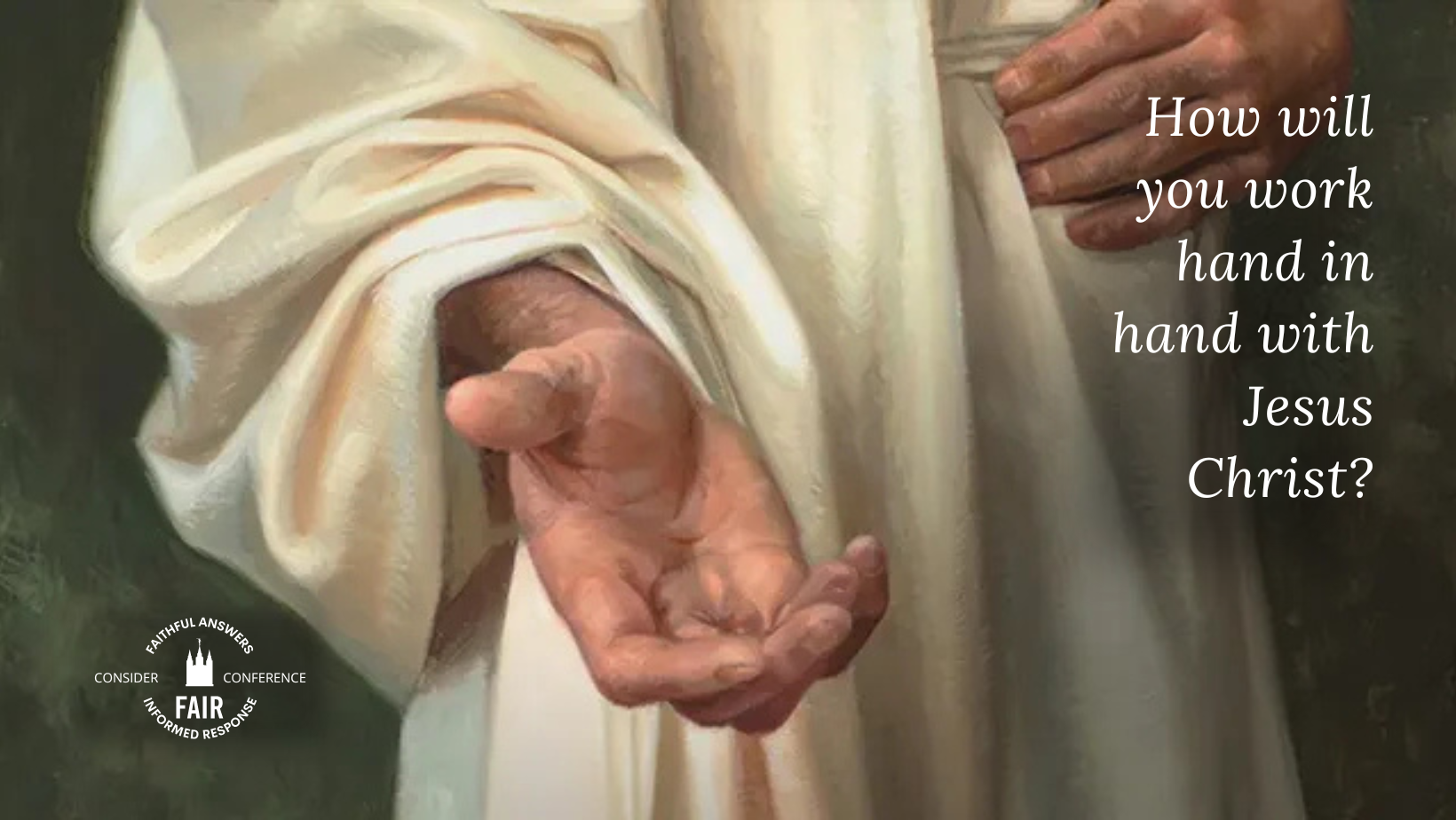
“As you fulfill your birthright responsibilities, you are never alone. The Lord of the vineyard labors with you. You are working hand in hand with Jesus Christ. With each new covenant—and as your relationship with Him deepens—you hold each other tighter and tighter until you are firmly clasped together… ‘O youth of the noble birthright, carry on, carry on, carry on!’ I testify that you are loved—and you are trusted—today, in 20 years, and forever. Don’t sell your birthright for a mess of pottage. Don’t trade everything for nothing. Don’t let the world change you when you were born to change the world.” – Brother Bradley R. Wilcox
Share your insight
Your thoughts and experiences can help others along their journey. Share them below, and let’s continue this conversation on sustaining the Savior’s light together.
The Consider Conference series by FAIR offers an in-depth look at recent General Conference talks to help members of the Church of Jesus Christ of Latter-day Saints navigate common questions, misunderstandings, and criticisms. Each post provides doctrinal insights, historical context, and practical ways to apply gospel principles in everyday conversations. Through this series, we hope to equip readers with faith-promoting resources that encourage thoughtful reflection, respectful dialogue, and a stronger foundation in gospel truths, fostering both personal conviction and meaningful discussions with others.
About the Author










Some of this message seems to have been written by someone using worldly terminology that does not fit well with gospel concepts/scripture:
“Eternal Families are not exclusionary but are meant to extend the concept of eternal love and connection.
“The Plan of Salvation includes everyone in God’s family, not just Latter-day Saints, and is a message of inclusivity and divine hope.”
The fact is, eternal families are entirely exclusionary; meaning they are exclusive to those who repent, believe, and obey, receive the sealing ordinance in the temples and endure to the end in righteousness. God will not love the rebellious and careless into heaven or into eternal families. You want it you earn it the way He prescribes. We are not a universalist church where everyone is eventually exalted and becomes like God.
In his book “The Holy Temple” Elder Boyd K. Packer shared this anecdote from an old Conference Report:
Elder Rudger Clawson spoke in General Conference of such an experience.
Some years ago, a brother approached me, and he said: “Brother Clawson, I am sixty-seven years of age; I have been a strong and active man in my life, and have done a great deal of hard work, but now I am somewhat feeble; I cannot engage in manual labor as heretofore. How shall I spend my time?” I said to him, “Go to the house of the Lord.” “Thank you,” he replied, “I will take your counsel.”
About eight years later, I met this brother again. He appeared to be very happy indeed; and there was an expression of joy in his countenance. “Brother Clawson,” he said, “during the past eight years I have been working for my ancestors, in the house of the Lord. After that conversation with you, I went east and I gathered up eight hundred names of my relatives; and during the past eight years I have personally officiated for three hundred of my ancestors, and I propose to continue on with the good work; I am happy for the Lord has blessed me.”
He further said, “I saw in a vision, upon one occasion, my father and mother, who were not members of the Church, who had not received the Gospel in life, and I discovered that they were living separate and apart in the spirit world, and when I asked them how it was that they were so, my father said: ‘This is an enforced separation, and you are the only individual that can bring us together; you can do this work; will you do it?'”-meaning that he should go into the house of the Lord and there officiate for his parents who were dead, and by the ordinance of sealing bring them together and unite them in the family relation beyond the veil; and he informed me that he had attended to the work, and I rejoiced with him and congratulated him. (Conference Report, October 1908, page 74.)
Yes, “the plan of salvation” can be construed to include everyone in God’s family, but that is an excessively broad definition of that phrase, different than I would suppose most Latter-day Saints view it. Of course all of God’s children fit in His plans, but if you define “salvation” as “exaltation” than such is not the case and we have a number of revelations indicating Celestial glory is quite exclusive (for those who meet the conditions) and certainly not all-inclusive. “Inclusive” is one of those words thrown around loosely today because it sounds so good and politically correct. But the third and highest degree of Celestial glory is not inclusive of all of God’s children. Only those who quality receive exaltation and most won’t pay the price. (And today I hear some people say they don’t want Celestial glory even if they could have it.)
As shown, there is “an enforced separation” in the spirit world for those who are not sealed together, and there is no movement, for all eternity, worlds without end, for those in lower kingdoms of glory into Celestial glory (D&C 132:17-18).
See also Elder Melvin J. Ballard:
https://archive.org/details/threedegreesofgl00ball
and President Dallin H. Oaks:
“The revealed doctrine of the restored Church of Jesus Christ of Latter-day Saints teaches that all the children of God—with exceptions too limited to consider here [Sons of Perdition]—will ultimately inherit one of three kingdoms of glory, even the least of which “surpasses all understanding.” After a period in which the disobedient suffer for their sins, which suffering prepares them for what is to follow, all will be resurrected and proceed to the Final Judgment of the Lord Jesus Christ. There, our loving Savior, who, we are taught, “glorifies the Father, and saves all the works of his hands,” will send all the children of God to one of these kingdoms of glory according to the desires manifested through their choices.
“Another unique doctrine and practice of the restored Church is the revealed commandments and covenants that offer all the children of God the sacred privilege of qualifying for the highest degree of glory in the celestial kingdom. That highest destination—exaltation in the celestial kingdom—is the focus of The Church of Jesus Christ of Latter-day Saints.”
https://www.churchofjesuschrist.org/study/general-conference/2023/10/17oaks?lang=eng
Offering is one thing; accepting and living a celestial law (or seeking so to do) is another. So it is only “inclusive” when desired and received and lived. Otherwise it is quite exclusive as D&C 76 thoroughly explains. DEI just isn’t gospel doctrine. God’s love is not “unconditional” and His laws are in effect.
See Pres. Nelson’s article for all the conditions and definitions of God’s love; it represents the position of the church:
https://www.churchofjesuschrist.org/study/ensign/2003/02/divine-love?lang=eng
Dennis, I appreciate the time you took to engage with my post. I think this conversation opens up an important dialogue about the interplay between inclusivity and the conditions necessary for exaltation. Let me address a few of the points you raised to clarify where I’m coming from, as well as to align with the teachings of the Church.
1. Eternal Families and Exclusion
You suggest that eternal families are “entirely exclusionary,” because only those who meet certain conditions will enjoy the blessings of eternal family life. I agree that the blessings of exaltation—including eternal families—are conditioned on repentance, covenants, and enduring to the end. As the scriptures teach, he who is not valiant in the testimony of Jesus shall not receive the crown over the kingdom of our God (D&C 76:79).
However, when I spoke of eternal families in the post, I was referencing the potential for all of God’s children to access those blessings through His divine plan. The Plan of Salvation invites all to come unto Christ and partake of these blessings. God’s love extends to everyone, regardless of their current standing, as shown in Romans 8:38-39, which teaches us that nothing “shall be able to separate us from the love of God, which is in Christ Jesus our Lord.”
Elder Dieter F. Uchtdorf emphasized this when he said:
“There is no threshold of perfection you must cross before God will help you. He will meet you where you are… He loves you today with a full understanding of your struggles.” (Come and Belong, April 2016).
While being sealed as eternal families requires us to make and keep sacred covenants, the invitation to come unto Christ, make those covenants, and be part of God’s eternal family is open to everyone. This is what I mean when I say eternal families are not exclusionary in nature—the invitation is inclusive of all; promised blessings are conditioned upon obedience (D&C 130:20-21).
2. Inclusivity and the Plan of Salvation
You mention that the phrase “the Plan of Salvation includes everyone” could be seen as excessively broad. But in reality, the Plan of Salvation absolutely is completely inclusive of all God’s children, regardless of their spiritual state. The Plan of Salvation is not “construed” to be inclusive – it is designed to be inclusive of all of God’s children.
President Dallin H. Oaks, in his recent talk, reminded us that what makes us different from other Christian churches is the fulness of the doctrine of Jesus Christ:
“Foremost among that doctrine is the fact that our Heavenly Father loves all His children so much that He wants us all to live in a kingdom of glory forever. Moreover, He wants us to live with Him and His Son, Jesus Christ, eternally. His plan gives us the teachings and the opportunity to make the choices that will assure us the destiny and the life we choose.” (Kingdoms of Glory, October 2023; emphasis mine).
Exaltation, of course, is conditioned upon living celestial law, but the Plan of Salvation itself, which includes the Atonement of Jesus Christ, is God’s gift to all His children. In other words, everyone is invited, though not all will choose to follow or qualify for the highest blessings.
This inclusivity is fundamental to the gospel message, even while the rewards of exaltation are exclusive to those who choose, by their agency, to live by God’s covenants.
3. Vision of Enforced Separation
You referenced Elder Rudger Clawson’s account of enforced separation in the spirit world for those who are not sealed. This does illustrate the importance of temple ordinances and sealing, and I agree that exaltation is predicated on those ordinances. However, this vision also underscores the hope of the gospel and the potential of eternal families. Even those who were not sealed in mortality can receive that blessing through the work of the temples, which is itself a reflection of God’s inclusive mercy.
The separation mentioned in Elder Clawson’s story wasn’t destined to be a permanent state—it was one that could be resolved through the sealing ordinances performed in the temple. This is what gives the gospel its universal hope: that redemption and eternal family relationships are available, even to those who didn’t have the chance to accept the gospel in mortality.
4. Inclusivity vs. Exclusivity in Exaltation
I agree with your point that exaltation is exclusive to those who exercise their agency to live celestial law, as outlined in D&C 76 and reiterated by modern prophets. However, inclusivity refers to the invitation and opportunity. The Atonement of Jesus Christ invites all to come unto Him. As the Savior taught, “Come unto me, all ye that labour and are heavy laden, and I will give you rest” (Matthew 11:28).
Elder Jeffrey R. Holland, speaking of the universality of Christ’s love and invitation, stated:
While the blessings of exaltation are exclusive to those who make and keep covenants, the invitation to receive those blessings is extended to all.
The gospel is not about turning people away, but about gathering them in and offering them the opportunity to qualify for exaltation through the ordinances of the temple.
5. God’s Love and Trust
You referenced President Nelson’s 2003 talk, Divine Love, on God’s love not being “unconditional,” and this is a vital distinction. As you pointed out, God’s blessings—including exaltation—are indeed conditional on obedience to His laws. But, as President Nelson also teaches in that same address:
“Divine love is infinite and universal.” (Divine Love, 2003). The “conditional nature of Divine love” that President Nelson spoke about describes a relationship of trust that our obedience and continual coming unto Christ creates.
It is critical to differentiate between trust and love. God’s love is extended to all His children—nothing can separate us from that love, as Paul testified in Romans 8. However, exaltation and the fullness of God’s blessings – a relationship of covenant and trust – are reserved for those who accept His invitation to enter into and keep sacred covenants, thereby creating a relationship of trust with Him.
In summary, while God’s love is not conditioned on our actions, the blessings He offers — including eternal family relationships — are. The gospel, however, remains a message of hope and inclusivity, where every person has the chance to qualify for those blessings through the exercise of their agency.