Introduction
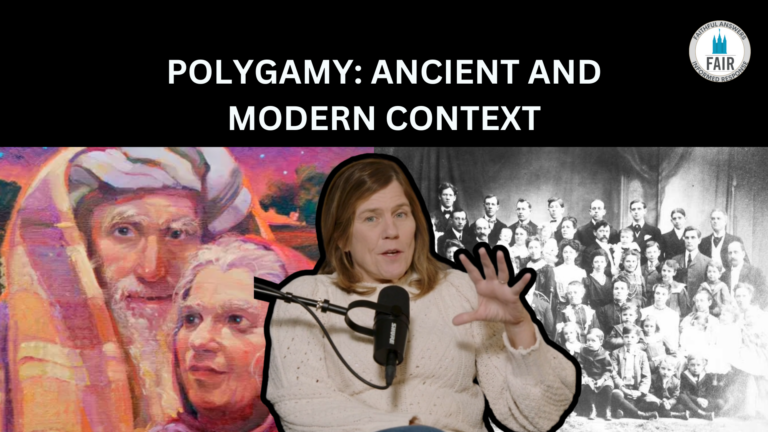
Since Mike Parker’s blog post on plural marriage has garnered more comments than all our other threads combined, my keen market research skills have told me that polygamy posts are traffic gold.
One of my research interests at FAIR is plural marriage, and I’ve been reading as much of the primary and secondary literature as I can get my hands on.
I thought our readers might be interested in a periodic look at a few of the things that I’ve found interesting, weird, or different from the common portrayals of plural marriage. In particular, primary sources that may have been misread or misrepresented, are also worth looking at. I hope that readers will spot things that I haven’t, or correct some of my own blind spots.
I’ll try to post at least once or twice a week, until people get bored, I run out of material, or FAIR tells me to stop so this doesn’t become the All Plural Marriage, All the Time blog.
The RLDS/CoC and Jacob 2:30
A key difference (arguably the key difference) between the LDS and RLDS churches is the issue of plural marriage. The “Brighamites” insisted that Joseph had both taught and practiced plural marriage, and that God endorsed the practice. The “Reorganites” tended (following Joseph Smith III) to insist that Joseph had never taught the practice. A few (such as Austin Cowles, formerly of the Nauvoo Stake leadership) argued that Joseph had taught or practiced plural marriage, but that Joseph was wrong to do so–he was a fallen prophet who either repented or didn’t.
Both groups did, at least, claim the Book of Mormon as scripture. Anti-Mormon (and even some ostensibly “objective” accounts, such as Richard Van Wagoner’s Mormon Polygamy: A history) always point to the general prohibition of plural marriage in Jacob 2. Usually unmentioned is verse 30, which LDS readers have seen as indicating that God may (under some circumstances) endorse plural marriage.
I recently encountered an alternate RLDS reading. It is by Richard Price, who “is a Reorganization conservative who interprets redirection in the church’s policy and doctrine as evidence of apostacy from the truths of the Restoration. He has become the chief spokesman for Reorganization fundamentalists, and a rival church organization is now developing around him.” [1]
Despite a tacit or overt admission by many RLDS members, leaders, and scholars that Joseph taught and practiced plural marriage in Nauvoo, Price and wife Pamela continue to insist that (in the words of their book and series of articles) Joseph Smith Fought Polygamy.
[Given that the Prices sometimes engage in anti-LDS polemic, accusing LDS leaders of fraud and the possible destruction or alteration of documents, I’ve not linked to their site as per FAIR policy. Anyone who is interested can certainly find it, though. I found some stuff I hadn’t seen before in their research.]
As probably goes without saying, I consider this stance historically untenable. The Prices have done some good research, however. Their analysis of difficulties which the physical layout of Joseph’s home presents for the folklore about Emma Smith reportedly pushing a pregnant Eliza R. Snow down the stairs adds to Beecher, Newell, and Avery’s analysis of the dubious textual and chronological evidence for this story. [2]
At other times, I think the Prices’ ideological commitment to absolving Joseph of plural marriage and blaming it all on the Brighamites trips them up. This brings me to the example I want to discuss today.
Jacob 2:30
Jacob 2:30 can be defanged, from the Prices’ point of view, if it excludes plural marriage. They attempt to do it thusly:
The Mormon Church leaders and missionaries still use the above passage to claim that God commanded them to practice polygamy to “raise up a righteous seed”—with the theory that children born of polygamy are more righteous than children born of monogamy, and that when God decides to establish an especially righteous people, He will command that they must practice polygamy.
They interpret this passage:
For if I will, saith the Lord of hosts, raise up [righteous] seed [or people] unto me, I will command my people [to practice polygamy]: otherwise [if the Lord does not give the commandment to practice polygamy], they shall hearken unto these things [Jacob’s instruction to not practice it].
This interpretation makes this passage completely out of harmony with all the rest of Jacob’s revelation against polygamy, and all of Joseph Smith’s writings which were printed before his death.
The true interpretation of the passage shows that it is definitely monogamous, and that it is in harmony with all the rest of the revelation which the Lord gave through Jacob. The true interpretation is:
For if I will, saith the Lord of hosts, raise up [righteous] seed unto me, I will command my people [the Lord will be their commander—He will give them commandments to obey]: otherwise [if the Lord is not their commander; or they do not obey His commandments], they shall hearken unto these things [they shall practice the sins of polygamy].
This is the true meaning of this passage—and therefore it condemns polygamy, rather than justifying it as the Mormon Church leaders claim.
This is certainly a creative reading. I see a few problems, however:
- The reading requires the “shall hearken” to be read as predictive (what will happen), not imperative (what should happen). Yet, in Joseph’s day, shall is typically an imperative when applied in the second and third person, not a future tense. [See Webster’s 1828 dictionary, “shall,” definition #2.]
- It seems strange for the Lord to say simply that He will be “their comamnder,”–the verse is clearly talking about commanding SOMETHING. And, it involves the Lord “will”[ing] something that He might not will in other situations.
- It ignores the fact that Jacob is almost certainly commenting on Deuteronomic (or Deuteronomy-like) writing about plural marriage in Judaic kings, some of whom clearly had wives given them by God. (e.g., 2 Sam 11:8) See here for analysis on these lines by FAIR.
I also wonder if the Prices’ reading of shall is idiosyncratic or typical for how the Book of Mormon uses it. Or the KJV?
So: is this a possible or probable reading of Jacob 2:30? Or has zeal lead the Prices’ astray? If so, what can LDS apologists do to avoid similar errors in their own efforts to read their own texts and articulate their own beliefs?
Discuss.
Important Note: I do not believe that anyone is currently authorized to practice plural marriage. Any comments arguing that plural marriage should be taught or practiced by the LDS Church (or anyone else) will be deleted without further warning. Get your own blog.
Notes
[1] Roger D. Launius,” An Ambivalent Rejection: Baptism for the Dead and the Reorganized Church Experience,” Dialogue: A Journal of Mormon Thought 23/2 (Summer 1990): 61n1.] (For more on Price, see William D. Russell, “Richard Price: Leading Publicist of the Reorganized Church’s Schismatics,” in Roger D. Launius and Linda Thatcher, eds., Differing Visions: Dissenters in Mormon History (University of Illinois Press, 1994), 319–340.)
[2] See Maureen Ursenbach Beecher, Linda King Newell, and Valeen Tippetts Avery, “Emma and Eliza and the Stairs,” Brigham Young University Studies 22/1 (Fall 1982): 86–96.
About the Author