
 It has been a volatile and emotional few days since the leak of new Church policies regarding same-sex marriage and children being raised in such marriages. We have discussed those matters already, and Elder D. Todd Christofferson of the Twelve has explained some of their rationale as well. The First Presidency also recently released further details.
Many are understandably emotional, and their compassion and concern reflects well upon them. Some questions will probably be addressed only on a case-by-case basis by the First Presidency.
Many “sound bite” or “bumper sticker” complaints on this topic have appeared on social media and elsewhere. Many of these reflect serious misunderstandings or distortions of LDS scriptures and doctrine. Few answers can come if we begin from inaccurate starting-points or assumptions.
We here review and correct a few of the most common.
The Second Article of Faith
“We believe that men will be punished for their own sins, and not for Adam’s transgression.” (2nd Article of Faith).
Some have claimed that the new policy violates this doctrine. This is mistaken, on at least three points:
First, the second Article of Faith is a rejection of the doctrine of “original sin” from creedal Christianity, which held that all mankind remained under condemnation for Adam’s sin. LDS doctrine, by contrast, teaches that Christ unconditionally atoned for this original sin, which is thus no longer operative (Moses 6:54). This Article of Faith has nothing to do with issues such as those presently under consideration.
Second, as Elder Christofferson has explained, the new policy is intended to protect children and their relationships and experiences from the consequences of others’ decisions. Unless one wishes to argue that the leaders of the Church are lying, there is no punishment being affixed at all, and none intended.
Third, Church doctrine nowhere teaches that children or others cannot be adversely affected by the choices of others. In fact, part of the tragedy of sin is that the negative effects of our actions may spill onto others. The Book of Mormon treats this matter repeatedly—the descendants of Laman and Lemuel were deprived, for a time, of gospel truths and ordinances because of the choices of their parents. The Lord made ample provision, however, for them to receive all possible blessings even if they had to wait.
We should instead “minister” to the children of same-sex marriages
Some have claimed that these children need to be “ministered” to—which is certainly true. The unstated presumption is that the Church and its members will not do so, or will be unable to do so, because of these policies.
In the Book of Mormon, the risen Lord spoke of those who are not yet eligible for baptism:
Nevertheless, ye shall not cast him out of your synagogues, or your places of worship, for unto such shall ye continue to minister; for ye know not but what they will return and repent, and come unto me with full purpose of heart, and I shall heal them; and ye shall be the means of bringing salvation unto them (3 Nephi 18:32).
Clearly, then, being a member of the Church—or even at present being eligible for Church membership—is not a prerequisite for being “ministered to.” Arguably, Church members are under even greater obligation toward such souls who are not at present full covenant members of the Church.
The policies announced will, to be sure, mark off minor children of same-sex marriages as somewhat distinct. This can have the effect, however, of focusing leaders’ and members’ attention upon them because of their unique situation. Approached with the proper attitude, the policy can thus emphasize and remind shepherds of the particular and unique needs of these members of the flock.
To “minister” is to serve. It is almost a truism to point out that we are commanded to serve everyone, regardless of their baptismal status, or even interest in joining the Church. There are many examples of ministering to those who are not members, only to have them later join the Church (e.g., Alma 22:23).
All can and should be “ministered” to—in and out of the Church, regardless of baptism. To insist or imply otherwise reflects either a deep confusion or sophistry.
“Suffer the Little Children to Come Unto Me”
In all three synoptic gospels (Matthew, Mark, and Luke), the disciples attempt to prevent parents from bringing small children to Jesus. Jesus rebukes the disciples, saying “Suffer the little children to come unto me, and forbid them not: for of such is the kingdom of God” (Mark 10:14).
Some imply that this means that Jesus would insist that all children be permitted to be baptized immediately. While a surface reading might lead some to that conclusion, an examination of the scripture’s context and other LDS doctrines demonstrates otherwise.
We will consider five areas that should be considered.
First, Luke’s account makes it clear that the “little children” were “infants,” and that the parents desired that Jesus “would touch them” (one presumes to bless them—Luke 18:15). The parents were not seeking baptism or membership in the covenant for the children; they were seeking a blessing or contact with Jesus.
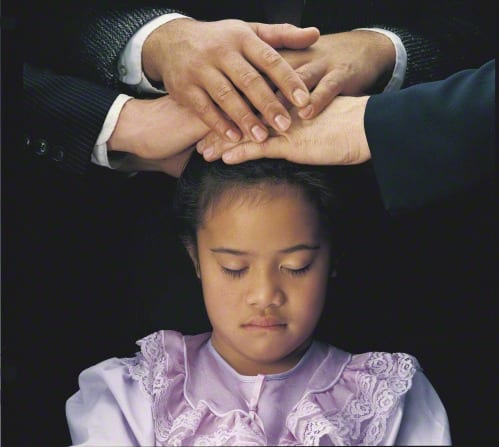
Second, pay attention to what happens immediately after Jesus makes his pronouncement: “He took them up in his arms, put his hands upon them, and blessed them,” says Mark, and “he laid his hands on them, and departed thence” recounts Matthew. Jesus did not baptize these children, or urge them to repentance as he did everyone else. Instead, he simply invoked God’s blessing upon them. (As discussed further below, such blessings are explicitly available under the new policy.)
Third, Jesus held out the little children as examples: “of such is the kingdom of heaven.” He did not, then, see these infants or young children as requiring baptism or repentance—they were already in a pure, saved state as they were.
Fourth, the Joseph Smith Translation teaches that the disciples tried to forbid the parents from bringing such children because they (the apostles) understood that such children were already saved. They therefore sought to spare Jesus’ time or attention for others that needed his saving ministry: “The disciples rebuked [the parents] saying, There is no need, for Jesus hath said, Such shall be saved” (JST Matthew 19:13, click footnote b).
Fifth, the Book of Mormon is clear that to claim that “little children” require baptism is to grossly misunderstand the gospel and the doctrine of Christ (Moroni 8; compare 3 Nephi 17). Mormon instructs Moroni to focus instead on “teach[ing] parents that they must repent and be baptized, and humble themselves as their little children, and they shall all be saved with their little children” (Moroni 8:10, emphasis added).
This meme thus misstates the context and teaching of the New Testament, Joseph Smith’s commentary upon the text, and the Book of Mormon’s clear instruction regarding baptism and “little children.”
Such children can already come to Christ and are already accepted by him without the need for any ordinances. Elder Christofferson emphasized that minor children affected by the policy can still have precisely what Jesus wanted to offer the children brought to him in the New Testament:
When we are talking about blessings, priesthood blessings, given to those who are ill or want a blessing of comfort or guidance, that’s open to all. We would expect that to be done throughout their lifetime, from infancy on as long as that’s the desire of the parents and of the child. That’s something we are anxious to provide…. Where there is any kind of need for blessing, for counsel, for help of whatever kind, that can be offered; we want to do that.
The policy explicitly permits, then, the provision of precisely what Jesus provided when he said, “Suffer the little children to come unto me.” The policy does not contradict these scriptures, it follows them precisely.
“Such children will be denied the gift of the Holy Ghost”
Church members understand that the influence of the Holy Ghost can be felt by anyone. However, they regard the “gift of the Holy Ghost” as a blessing which accompanies baptism and confirmation. As Joseph Smith taught:
There is a difference between the Holy Ghost and the gift of the Holy Ghost. Cornelius received the Holy Ghost before he was baptized, which was the convincing power of God unto him of the truth of the Gospel, but he could not receive the gift of the Holy Ghost until after he was baptized. Had he not taken this sign or ordinance upon him, the Holy Ghost which convinced him of the truth of God, would have left him.[1]
Thus, this concern has perhaps the most superficial plausibility of the issues we’ve considered here.
It omits, however, a crucial factor. We must not be so legalistic as to think that God is hamstrung or restricted until an ordinance is performed. An ordinance and the covenant that accompanies it is not a magic ceremony of some sort. It is, instead, a physical symbol and public expression of our inner commitment to God. The associated covenant is ratified by the necessity of God’s priesthood power and supervising priesthood keys performing and authorizing it. But, God may bestow his gifts and blessings upon whomever he chooses, especially if they are at present unable to participate in the ordinance that is usually required.
In Joseph Smith’s example, Cornelius would not have had the Holy Ghost to continue with him had he refused baptism, since he would be making a choice to reject the ordinance which God commanded him to undergo.
If, however, Cornelius had his experience prior to Jesus’ resurrection, he could not (yet) have been baptized, since Jesus instructed his disciples to only approach the House of Israel (Matthew 10:6, 15:24). Would we really expect, however, that Cornelius would have then lost the spirit of God in his life simply because he could not be baptized, through no fault of his own? Of course not.
God simply does not operate with such capriciousness. If a non-member is invited to be baptized, has the means and opportunity, and refuses, then she cannot expect the Holy Ghost to continue with her. She has refused to obey, and refused to make a covenant. However, if a non-member is unable—for whatever reason—to be baptized, God will not condemn or penalize her for an opportunity she does not have. There are many throughout Church history who have not been able to be baptized for many years, due to political or other reasons.
One well-known example is Italian Latter-day Saint Vincenzo Di Francesca, who discovered the Book of Mormon in 1910, but did not know to what church it belonged.[2] He was censured by his own Christian denomination for preaching from it, and only learned the identity of The Church of Jesus Christ of Latter-Day Saints in 1930. An apostle came to baptize him in 1932, but was prevented by political strife. Other attempts were made, but these likewise failed. From 1940–49, no contact with the Church was possible. Vincenzo was finally baptized in 1951. He had thus desired baptism for over forty years.
We do not believe, however, that God would not or did not bless such a faithful believer abundantly, despite a lack of baptism through no fault of his own. (A Church video— How Rare a Possession— has dramatized the story of Vincenzo, and can be viewed on-line.)
The Doctrine and Covenants teaches that when righteous people are prevented from fulfilling a commandment of God through the actions of others, God does not require that commandment to be fulfilled. He also does not punish those who do their best. (See D&C 124:49.)
Latter-day Saints ought to understand this concept better than almost anyone, since our doctrine of vicarious ordinances for the dead makes it clear that God does not punish his children for that which they have not yet had the opportunity to receive.
As President Joseph F. Smith taught:
The presentation or “gift” of the Holy Ghost simply confers upon a man the right to receive at any time, when he is worthy of it and desires it, the power and light of truth of the Holy Ghost, although he may often be left to his own spirit and judgment.[3]
The “gift of the Holy Ghost” is thus a blessing of the covenant; it gives “the right” to this blessing if we are faithful. But this does not preclude God bestowing such a blessing on others who are worthy, according to his own mind and merciful purposes. As President Harold B. Lee observed, “The bestowal of the gift [of the Holy Ghost] is actually, then, a command to so live that when we need and desire it, we may have the accompaniment of the power of the Holy Ghost.”[4]
Any believer who is unbaptized through no fault of his or her own can keep this commandment, and reap the promised blessings as well. When asked what would happen to those who believed, and yet were prevented from obeying a commandment, President Joseph F. Smith said: “I reply that every man and woman will receive all that they are worthy of, and something thrown in perhaps on the score of the boundless charity of God.”[5]
Conclusion
It is understandable that good and faithful people may have questions about how this new policy will be administered. We encourage any with questions to study the scriptures, reflect upon what apostles and prophets have to say on the matter, ponder and pray, exercise patience, and look deeper than the slogans, memes, and sound-bites.
[1] Joseph Smith, cited in “For the Times and Seasons. SABBATH SCENE IN NAUVOO; March 20th 1842,” Times and Seasons 3/12 (15 April 1842): 752; see also History of the Church 4:555.
[2] See “I Will Not Burn the Book,” Ensign (January 1988), https://www.lds.org/ensign/1988/01/i-will-not-burn-the-book?lang=eng.
[3] Joseph F. Smith, Gospel Doctrine (Salt Lake City, UT: Deseret Book Co., 1959), 60–61.
[4] Teachings of Harold B. Lee (Salt Lake City, UT: Deseret Book Co, 1996), 96.
[5] Joseph F. Smith, Journal of Discourses, 20:30–31 (7 July 1878).
About the Author









Greg, this is helpful. Thank you. I’m one of those who was initially disturbed by the policy. As I’ve given it more thought, some of my concerns have subsided (your discussion of the HG is actually very helpful), but I remain opposed. Here’s why.
The FP/Q12 have the authority and responsibility to decide what is best for the church. Members can disagree with their decisions. And these leaders certain are not infallible. But because of their position and access to the fullest information, I accept that they are best positioned to direct the affairs of the church. And I trust the Lord will correct mistakes over time (as what happened with the priesthood ban).
That said, the FP/Q12’s scope of authority is limited. For instance, they don’t set policy for people in other galaxies or on the other side of the veil. They don’t have authority to conduct resurrections (a point Elder Oaks taught in conference in few years ago). And they don’t have authority to bind future church leaders.
Here, the church has overstepped its bounds. The only rationale given by the church for the policy is that this is best for children raised in SSM households; specifically, that it will minimize discord in such homes.. In my view, that is simply not a decision the church should be making. The decision should be made by the children and their parents. If the family is in agreement for the child to be baptized, etc., the church should not decline on the presumption it actually knows what is best for that family.
Now, if the FP/Q12 want to give a church-based rationale for the policy – say, because of legal concern or to avoid conflict in church circles – that’s fine. I may disagree, but I respect their authority to make the decision. But so far the only rationale given has been one which families, not the FP/Q12, should be deciding.
One follow up to by comment. The principle of circles of authority is why I see this policy differently from the polygamy policy. While I don’t have personal experience, my understanding is that that policy was enacted because polygamous families were abusing the church – basically sending kids to get ordinances done (including in the temple) so they could persist in their claims to having authorized polygamous family units.
In the polygamy situation, I can understand the need to protect the church from parents who encourage baptism, etc. for purposes contrary to the church. But that’s quite different from the current situation where gay parents actually support their children’s involvement in the church and are not trying to create a competing faith to usurp the LDS church’s authority claims.
And of course, the big issue is that the polygamy policy was enacted based on concern for the church itself – the sphere where church leaders have authority – rather than supposed concern for the homes of the children – where parents (even gay ones) have authority and the right to revelation.
Dave K,
While I am still to struggling to know how I feel about the policy changes(and I might not feel the same about all of them equally), I appreciate your thoughtful and respectful approach to disagreement. I wish I had seen and will see more of that. I don’t know if I necessarily agree with you, but I appreciate hwo you have handled your disagreement.
This post fails in its effort to show “mistaken claims” associated with the church’s policy. At best, it could be entitled “an alternative point of view regarding the church’s policy.”
Regarding the 2nd Article of Faith arguments: I don’t hold to the position that the policy “violates doctrine,” but if I did, I wouldn’t be convinced. 1) Who cares if it was originally a rebuttal of “original sin?” It says what it says. (2) Who cares if the policy is “intended” to protect children? Its intent is irrelevant to whether it actually hurts children. There are many anecdotes of children who feel hurt by the policy and family and friends who feel that it hurts children. So an argument that it is intended to protect them has no bearing on whether there is actual harm. (3) No one I know of claims that children “cannot be adversely affected by the choices of others.” I think people just feel that the Christ’s church should not be the one administering the adverse effects upon the children, in a very direct manner.
I could go on, point by point, but that would be pointless. Instead, I’ll add two thoughts. People FEEL that the policy is wrong. When I told my wife about it, she burst into tears and cried for hours. I was stunned by her reaction. I am more cerebral, and like Dave K I was “initially disturbed by the policy” but had at least come to understand it, if not to agree with it. But when my wife started bawling, I came to believe that all of our first reactions is the correct one: this policy is wrong, and most of us know it, or knew it when we first heard it. And that brings me to my second thought: it just can’t be a good sign when a policy intended to protect children requires so much clarification and defense. Such a policy, including its application to polygamist families, at least deserves a second look. I think a far better policy would merely be informed consent of all parties regarding the church’s beliefs and what would be taught to the child or teen.
I guess I’ll add a third point: thank you for not asserting that opposition to the policy is the same as opposition to church leaders. I think far more people will be driven from this church from intolerance than from a policy that will likely be gone in a couple of years.
Dave, I would make a couple of observations in response:
1. The FP/Q12 does, to some degree, set policy for those on the other side of the veil by decreeing that certain populations of the deceased (e.g. Holocaust victims) are ineligible for proxy temple ordinances.
2. Unless one subscribes to one of various branches of fundamentalist Mormonism, it should be pretty straightforward that the keys of priesthood authority reside with the church leadership and not with the family. Determining the manner of administration of the saving priesthood ordinances, and vetting the candidates who wish to receive those ordinances, is very much within the purview of the LDS church leadership (“presiding high priests”, “common judges in Israel”, and all that . . .). Moreover, since any priesthood authority a family head *does* wield seems to expire due to unrighteousness (see D&C 121), the spiritual authority of a man who is regularly committing sodomy without a shade of repentance would seem to be rather tenuous–at least where administration of priesthood ordinances is concerned.
3. Mormonism can handle disconnects between what children learn at church and what they observe in their home life. Heck, we do it all the time; and we generally resolve those disconnects by holding out the hope for future repentance and redemption–a nonmember parent may be baptized, an inactive parent might quit, cohabiting parents might someday marry. But for a parent in a same-sex marriage, there is no repentance except through divorce. How do you explain that to a kid?
I think the Mormon left understood the difficulty of the situation, and I think they were largely hoping that the Church would legitimize gay marriage rather than force these sorts of conversations. (“Children are delicate! They can’t handle the conflict! These kids are killing themselves! You don’t want to be responsible for that, do you?”)
Instead, the Church simply said “you know what? You guys are right, this is a hard thing we’re asking. So, we’ll delay these sorts of conversations until the kids are older and ready to deal with the emotional fallout”. And, that’s the galling thing: The leadership outfoxed the pseudo-moderates of the LDS left by giving them EXACTLY what they (were preparing to claim they) wanted. With the table set and the game about to begin, these doddering old bigots simply stood up, said “hey, you win!”, and tottered away; leaving leftists to sputter “But . . . but . . . you’re turning your back on the children!!!!”–never stopping to consider who it was that put the children on the table as pawns in the first place.
JimD, most of your comment does not address mine. So I’ll leave the sodomy, divorce, and pawn issues for others.
My point was simply that parents have the right to govern their own families. The church generally does a good job of respecting this, even (especially) when the parents are not members or when they are living far outside church standards. But with the new policy the church oversteps that line. It presumes to know what is best for family harmony regardless of the family’s decision. I’m not disputing the church’s right to control its priesthood keys. I’m disputing its capacity and authority to pass final judgment the issue of whether church membership enhances or detracts from the harmony of these families. I say let the families decide.
If it is true that the little ones Christ was referring to were infants, and not toddlers or adolescents, then isn’t the ban on baby blessings for infants still against the scriptural canon?
The justification used for denying children baptism based upon their parents sins seems also applicable to children living with excommunicated or cohabitating heterosexual parents. If the Q12 and First Presidency were truly acting out of love and concern for the children in the homes of gay couples, why would they have such spiritual disregard for children in these other situations?
One topic not covered that I would like to understand is why the ordinance of baptism or being ordained to the Priesthood are what is restricted, not church participation. Cognitive dissonance and colliding teachings between parents/church will still occur in the children, even with ordinances restricted, as long as they are still participating at church. However, now the children will likely also face ostracization from their priesthood group, on temple trips, passing the sacrament, or in discussions on planning for missions, etc. What is it about the ordinance of baptism, and the covenant that goes along with it, or being ordained to the Priesthood, that would more greatly harm the child than merely participating?
The current baptismal interview questions ask nothing about confirmatory beliefs in only heterosexual relationships, they only ask if the individual themselves will “Live the Law of Chastity”. So, why would this covenant cause dissonance?
The Book of Mormon states that those who are ‘without a law’ are not under condemnation, so basically the Church is saying that these children will be regarded as ‘without the law’ at least until they are able to live in a situation outside of the influence of a ssm. They won’t be condemned because according to doctrine, with the exception of sons of perdition, no one is declared condemned, they just aren’t redeemed YET. We see this in proxy baptism. They basically just have an extra step in the process of preparing for baptism, which is not an unusual thing at all. People who struggle with the Word of Wisdom have to wait until they have dealt with it, people who have committed felonies have to deal with the consequences of that and no longer profit from crime before they are baptised. I think the new baptism policy might be summed up as “If you are implying support for ssm, or being supported by a ssm couple by living under their roof, you have to stop that before baptism.”
First, I am amazed that people thought the things that Greg writes about. I agree with what Greg wrote but am not clear as to how some came to have these concerns. Yes, I have read some of these “concerns” online, but am still amazed that the “concerned” people don’t know the difference between a child under 8 and a young person between the ages of 8 and 18, nor do they seem to recognize the stresses that such a baptism could bring upon all involved.
And then there are Dave K’s comments. How did “other galaxies” get into this discussion? How can he say that it is the province of the young person and their “parents” as to whether the child is eligible to be baptized? How is it possible for the Brethren “to overstep their bounds” when deciding who is ready to enter into the waters of baptism, who is ready to enter into covenants which have eternal consequences if violated? No one has the authority to say “I want to be baptized; baptize me now.” All must be interviewed and be deemed, through the guidance of the Spirit and the guidelines established by the Brethren, to be ready.
My impressions of these clarifications/changes/whatever one wishes to call them – my first impression was that the Church was making an effort to minimize the discord in a same-sex family home because a child who had, for whatever reasons, decided to get baptized. Because of the teachings of the Church on same sex unions, and even more so the dissonance created by those who oppose those teachings, a young person would be put in a very difficult emotional situation, as would the entire family, by joining the Church. Nothing in this policy prevents the young person, or the same-sex couple for that matter, from attending Sunday services or activities, or from receiving blessings. But the main point that I took away from this is that the young person is given the opportunity to enter the waters of baptism only after he has enough life experience to separate all of the emotions surrounding both his love of the Gospel and his love of his parents, and is living outside the influence of the situation, so that s/he may have the best chance of living up to the covenants s/he has made.
But those are just my impressions. What I do know is that the brethren have the complete authority from the Lord to provide this loving guidance, regardless of how I or anyone might feel about it. The Lord leads this Church through his servants, the Prophets. Amos knew this truth, and so do I.
Well done, Greg. Very well presented points. I so appreciate a source for discussion that does not a priori presume to criticize the Church.
Dissenters don’t have to agree, they can raise all the distractions they please, but they cannot make the truth go away.
An appropriate quote from President Monson…
insidious influences with which we are surrounded and which distort the truth, tear down the good and the decent, and attempt to substitute the man-made philosophies of the world. If the commandments had been written by man, then to change them by inclination or legislation or by any other means would be the prerogative of man. The commandments, however, were God-given. Using our agency, we can set them aside. We cannot, however, change them, just as we cannot change the consequences which come from disobeying and breaking them.
On 11/19/2015 12:29 PM, John W. Redelfs wrote:
I thought that Greg Smith’s piece was wonderful. It touched my heart, and if there was anything untrue in it, I could not discern it. If the blessings of heaven were not available to those who have not entered into ordinances such as the blessing of a baby or baptism at the age of eight, where would I be? More than half the Church are converts through baptism. All of the original members including Joseph Smith started out as nonmembers. What reason would any of them have for joining with the Church of Jesus Christ if such ordinances were essential at some arbitrary and specific time. It takes God’s love and inspiration from him to even desire to belong to his Church.
Another thing, I was unable to join the Church when I learned from the Holy Ghost that it was true. My father wouldn’t allow it, and the Church would go against my father because I was still a minor living at home. But even before I turned eighteen, my dad changed his mind and gave his consent. Why? The Holy Ghost was obviously working on him too. Shortly before he died in 2000 AD, even though he was still a atheist his hard core certainty started to crumble, and he asked my wife and I to do all that “temple stuff” we Mormons do after he was dead, “just in case.” He wanted to cover his bets, to make sure he had all his bases covered just in case he was wrong about there being no God. Of course, we did all of his work shortly after his death.
Question: Would my dad have reached out to me, my wife, my children and commented on the “spirit” in our home if the Holy Ghost had not been still working with him? My mother, being an iron clad evangelical Baptist never would have consented to my baptism as a dependent minor. Her mind was already made up. We have done her work too, but I just feel a lot better about my dad. It is important that we all realize there are things we don’t know, and don’t get frozen into world views and opinions that might be wrong.
Of course, I do not know whether either of my parents have accepted the gospel on the other side. But I am hopeful. And in either case, I am uplifted and comforted by Greg Smith’s piece. I think I already knew most or all of it, but there are times when we need to be remind of those things that strengthen us in our moral struggles. Today, I am deeply depressed as I have been for nearly two months, but Greg’s piece was uplifting because it lifted me up. And that is another gift of God. Soon I’ll need a bigger house because I am running out of closets and corners where I can put them all.
The 137th Section of the Doctrine & Covenants is also a great scriptural resource for these issues. Anybody who would have recived baptism, but was prevented (by chance, location of birth, era of birth, family interferance or policies such as this on under discussion) but who in the judgement of the Lord would have recived it and been faithful, will still be an heir in the Celestial Kingdom.
As Greg has pointed out, the policy is internally consistent, in that the Lord will not deny blessings to those he has placed in this position.
One question. I just have one question. How does it make sense to treat children in same-gender families differently from how we treat children in cohabitation families??? All the explanations fall apart if that question does not get rationally answered.
NO ONE has answered that question!
A stake president of my acquaintance had a female gay couple in his stake who had a child. Then one of the women underwent a sex change operation. They were excommunicated. They are moving to another location where they want to have the transgendered person “convert” to the church as a man, and then work towards a temple marriage and sealing of the child. I know. What a world we live in. But it is entirely appropriate I think for the church to set very clear and definite boundaries in such a world. Two hundred years after Christ visited the Americas, that church begin a slide into apostasy and interestingly, the sin mentioned in the Book of Mormon is that “they did deny the more parts of his gospel, insomuch that they did receive all manner of wickedness, and did administer that which was sacred unto him to whom it had been forbidden because of unworthiness.” 4 Nephi 1:27
Many I have spoken with say the church should never have attempted to write a policy on this subject/situation and left it to local leaders to deal with the very few cases that might come up.
What if anything is wrong with this Monday morning quarterbacking?
My personal opinion is to agree with those who say ” They should have let it alone as far a promulgating a policy that seems to be leaking like a sieve”.
It is written in the scriptures regarding same sex marriage …. There are commandments, We have the “A Family Proclamtion to the World that clearly explain why it is important that man and woman shall marry… We should follow what the Lord has instructed for us to do… Children of today are now intelligent …they know and understand what is happening in their surroundings… They are the one who can decide for themselves to know the truth …they are not dumb… As long as you leave the gospel,of Jesus Christ you have the Wisdom to know the truth and that is already a blessing… FP/Q12 they are here to guide and counsel us …same as God speak of us before …today and tomorrow even in the future….Continue raeding…searching…pondering the sriptures …it will help you to bring peace in our hearts and lead us to righteous living…if it is not of God it is of the devil.!
Within this whole context of the changes is something that seems to be bothering some people, which has not been mentioned. It is the use of the word “apostate” to describe a person in a non-Church recognized relationship. It seems a harsh word to use, unless that person is actively advocating against the Church. Any thought?
The difference of children of cohabitation couples and same sex “marriages” is that the former are not trying to say that they are right and everybody else are wrong, that’s the claim of the same sex marriage couples. This is big difference int terms of the children. Obviously is also the fact than in the cohabitation, exist both parents for the children.