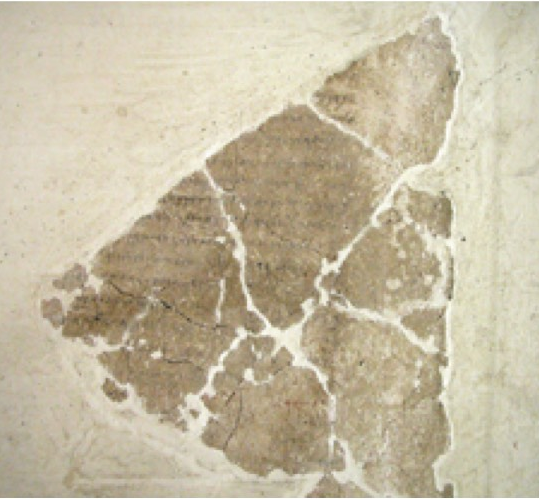
Balaam Son of Beor Inscription from Deir ʿAllah. This fragment, dating to several centuries after the events of Numbers, recounts a night vision of Balaam, son of Beor, a “seer of the gods.” Though the content of the vision has nothing to do with the Bible story, the text provides evidence that stories surrounding the figure of Balaam were known anciently outside the Bible among peoples who lived in the area east of the River Jordan.
An Old Testament KnoWhy relating to the reading assignment for Gospel Doctrine Lesson 16: “I Cannot Go Beyond the Word of the Lord” (Numbers 22-24; 31:1-16) (JBOTL16A)
Question: Have there been any latter-day parallels to Balaam’s blessing?
Summary: In 1898, Dr. John M. Reiner, a Roman Catholic scholar, visited Utah. In a talk given at the Salt Lake Tabernacle at the invitation of President Wilford Woodruff, he described in striking terms the parallels he found between ancient and modern Israel. Throughout his talk, he wove in colorful and informative allusions to the story of Balaam, who had blessed Israel in spite of himself. Reiner also spoke vigorously of the strength of the claims of apostolic authority that, in his view, had been credibly put forth by only two churches: the Roman Catholics and the Mormons. Although not claiming the gift of prophecy, Reiner’s eloquent words of appreciation and friendship for the Latter-day Saints were sincere and generous. His little-known discourse drawing out modern day parallels to the story of Balaam and Israel deserves to be better known.
Jeffrey M. Bradshaw (PhD, Cognitive Science, University of Washington) is a Senior Research Scientist at the Florida Institute for Human and Machine Cognition (IHMC) in Pensacola, Florida. His professional writings have explored a wide range of topics in human and machine intelligence (see en.wikipedia.org/wiki/Jeffrey_M._Bradshaw; www.ihmc.us/groups/jbradshaw).
Jeff serves as a vice president for The Interpreter Foundation and is on the Advisory Board for the Academy for Temple Studies. He has lectured at BYU Campus Education Week and the Sidney B. Sperry Symposium and has presented at FairMormon meetings in the United States, Germany, and France. His articles on temple studies and the ancient Near East have appeared in Studies in the Bible and Antiquity, Element: A Journal of Mormon Philosophy and Theology, Interpreter: A Journal of Mormon Scripture, Meridian Magazine, and BYU Studies. Jeff has written detailed commentaries on the book of Moses and Genesis 1-11 and on temple themes in the scriptures. For LDS-related publications, see www.TempleThemes.net.
Jeff was a missionary in France and Belgium from 1975–1977, and his family has returned twice to live in France: once from 1993–1994 as a Fulbright Scholar and a second time from 2005–2006 as an unexpected “sabbatical” in the aftermath of Hurricane Ivan. Jeff has served twice as a bishop and twice as a counselor in the stake presidency of the Pensacola Florida Stake. He and his wife, Kathleen, are the parents of four children and eleven grandchildren. In July 2016, they began two years of service in the Democratic Republic of Congo, Kinshasa Mission.