Introductory Pages of the Book of Mormon
“[The Book of Mormon] seeks to convince all that Jesus is the Christ”
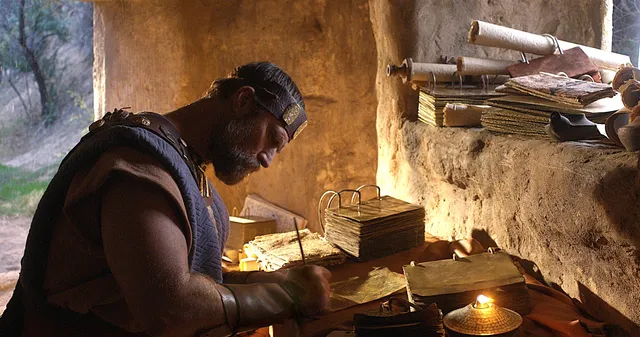
“[The Book of Mormon] seeks to convince all that Jesus is the Christ”
FAIR Faithful Resources for Come, Follow Me 2024 January 1-7. Introductory Pages of the Book of Mormon: “Another Testament of Jesus Christ.” These trusted sources can help you find answers to difficult questions and help you in your learning and teaching.
Jump to section

Main Points to Ponder
- Authorship and Translation: The introduction establishes that the Book of Mormon is a translated record of ancient American prophets, compiled and abridged by Mormon and his son Moroni.
- Spiritual Purpose: The Book of Mormon is another testament of Jesus Christ and is a means of restoring essential truths and principles that may have been lost or corrupted over time.
- Historical and Geographical Context: The introductory section provides a framework for the historical and geographical setting of the Book of Mormon. It describes events occurring in the Americas from around 600 BCE to 421 CE, offering a unique perspective on ancient civilizations.
- Testimony and Invitation: The introduction concludes with a testimony, affirming the divine origin and purpose of the Book of Mormon. Readers are invited to seek personal revelation to determine its truthfulness. The Book of Mormon urges all to come unto Christ and be reconciled to God through faith in Jesus Christ.
Faithful Answers to Difficult Questions
The Church changed the wording to remove the assumption (inserted into the Book of Mormon in the 1981 edition) that all of the inhabitants of the Americas were exclusive descendants of Lehi
The Church made the change in wording to the introduction to the Book of Mormon to remove the assumption, which inserted into the Book of Mormon introduction in the 1981 edition and not part of the original text, that all of the inhabitants of the Americas were exclusive descendants of Lehi. This had been the generally held belief from the time that the Church was restored.
This change makes the Book of Mormon introduction compatible with current DNA evidence and acknowledges the fact that Lehi’s group likely intermingled with the native inhabitants of the American continents based upon current knowledge of the DNA composition of the inhabitants of the New World. There is substantial scientific evidence of habitation in the Americas for thousands of years prior to Lehi’s arrival.
If Lehi had any descendants among Amerindians, then after 2600 years all Amerindians would share Lehi as an ancestor. Even if (as is probable) the Lehite group was a small drop in a larger population ‘ocean’ of pre-Columbian inhabitants, Lehi would have been an ancestor of virtually all the modern-day Amerindians if any of his descendants married into the existing New World population.
See answer page 🡒
ANSWER_2
See answer page 🡒
The witnesses had much to gain by denying their experiences
Martin Harris noted that he would have been well-paid if he was willing to deny his witness:
A few hours before his death and when he was so weak and enfeebled that he was unable to recognize me or anyone, and knew not to whom he was speaking, I asked him if he did not feel that there was an element at least, of fraudulence and deception in the things that were written and told of the coming forth of the Book of Mormon, and he replied as he had always done so many, many times in my hearing the same spirit he always manifested when enjoying health and vigor and said: ‘The Book of Mormon is no fake. I know what I know. I have seen what I have seen and I have heard what I have heard. I have seen the gold plates from which the Book of Mormon is written. An angel appeared to me and others and testified to the truthfulness of the record, and had I been willing to have perjured myself and sworn falsely to the testimony I now bear I could have been a rich man, but I could not have testified other than I have done and am now doing for these things are true.[1]
One non-member noted that the excommunicated Oliver Cowdery would have been the editor of a Democratic Party newspaper, “but was dropped on the discovery that he was one of the seven founders of Mormonism.”[2] Cowdery would have been advantaged to have denied his witness, but did not. Later, in 1848, an opposing political party opposed Cowdery’s Democratic candidacy partly because he was “one of the three witnesses to the discovery of the Golden Plates, or Mormon Bible, by Joe Smith.”[3] Richard Anderson noted that citations from the Book of Mormon were then used as “the basis of personal sarcasm against Cowdery.”[4] Again, Oliver would have been advantaged to distance himself from his testimony and witness, but did not.
See answer page 🡒
The witnesses never refuted their testimony in the Book of Mormon. In fact, David Whitmer even affirmed it “as then made and published”
It is claimed that no document exists of the testimonies of the Three and Eight Witnesses which contain their actual signatures, and that this somehow invalidates their testimonies as printed in the Book of Mormon, and that the witnesses statements in the Book of Mormon manuscript are written and signed only by Oliver Cowdery.
The claim that the witnesses somehow didn’t agree with their testimony as it was printed in the Book of Mormon during the entire period of their lives is nonsense.
The printer’s manuscript of the Book of Mormon is entirely in Oliver Cowdery’s handwriting, including the witness statements
The printer’s manuscript is a copy of the original Book of Mormon manuscript. This copy was made by Oliver Cowdery and taken to the printer. Therefore, the entire document is in Oliver’s handwriting. The original manuscript was placed in the cornerstone of the Nauvoo House.[1] Years later, it was removed and found to have been mostly destroyed by water damage. As a result of this, we do not have the portion of the original Book of Mormon manuscript containing the witness statements. It should be noted that in the 1830 Book of Mormon, the witness statements were included at the end of the book, rather than at the front as they are today.
See answer page 🡒
Emma Smith:
Emma Smith said in later interviews:
Q.-Are you sure that he had the plates at the time you were writing for him?
A.-The plates often lay on the table without any attempt at concealment, wrapped in a small linen tablecloth, which I had given him to fold them in. I once felt of the plates, as they thus lay on the table, tracing their outline and shape. They seemed to be pliable like thick paper, and would rustle with a metallic sound when the edges were moved by the thumb, as one does sometimes thumb the edges of a book….
“Q-Could not [Joseph Smith] have dictated the Book of Mormon to you, Oliver Cowdery, and the others who wrote for him, after having first written it, or having first read it out of some book?
“A.-Joseph Smith could neither write nor dictate a coherent and well-worded letter; let alone dictating a book like the Book of Mormon. And, though I was an active participant in the scenes that transpired, and was present during the translation of the plates, and had cognizance of things as they transpired, it is marvelous to me, ‘a marvel and a wonder,’ as much so as to anyone else.
“Q.-I should suppose that you would have uncovered the plates and examined them?
“A.-I did not attempt to handle the plates, other than I have told you, nor uncover them to look at them. I was satisfied that it was the work of God, and therefore did not feel it to be necessary to do so.
“Major Bidamon here suggested: Did Mr. Smith forbid your examining the plates?
“A.-I do not think he did. I knew that he had them, and was not specially curious about them. I moved them from place to place on the table, as it was necessary in doing my work.[1]
Also:
Q: “Do you believe that your husband, Joseph Smith died true to his profession?”
A: “I believe he was everything he professed to be.”[2]
Lucy Mack Smith:
I trembled so with fear, lest all might be lost in consequence of some failure in keeping the commandments of God, that I was under the necessity of leaving the room in order to conceal my feelings. Joseph saw this, and said, “Do not be uneasy mother, all is right—see here, I have got a key.”
I knew not what he meant, but took the article of which he spoke into my hands, and, upon examination, found that it consisted of two smooth three-cornered diamonds set in glass, and the glasses were set in silver bows, which were connected with each other in much the same way as old fashioned spectacles. He took them again and left me, but said nothing respecting the Record.[3]
Mary Whitmer:
Mary Musselman Whitmer (August 27, 1778 – January 1856) was the wife of Peter Whitmer, Sr. Through her son David Whitmer, she and her family became acquainted with Joseph Smith, Jr. around 1828. In 1829, probably during June, she was caring for three boarders (Joseph Smith, Emma Hale Smith, and Oliver Cowdery) in addition to her large household while the Book of Mormon was being translated. She said she was often overloaded with work to the extent she felt it quite a burden. During this time, the male boarders and members of her household were speaking of being shown the Golden Plates. One evening when she went to milk the cows, she said that a stranger with a knapsack spoke to her, explained what was going on in her house, comforted her, then produced a bundle of plates from his knapsack, turned the leaves for her, showed her the engravings, exhorted her to faith in bearing her burden a little longer, then suddenly vanished with the plates. She always called the stranger “Brother Nephi.”
See answer page 🡒

Section Summaries
The Book of Mormon, translated by Joseph Smith, is an abridgment of ancient records written by the hand of Mormon. It addresses Lamanites, Jews, and Gentiles, bearing commandments, prophecies, and revelations, emphasizing God’s role in the house of Israel, the covenants, and Jesus Christ’s divinity while acknowledging human errors.
Open in Gospel Library 🡒
The Book of Mormon is a sacred text, akin to the Bible, detailing God’s dealings with ancient American civilizations. It contains the full gospel, recorded by prophets through divine revelation. The book mentions two civilizations—the Nephites and Lamanites from Jerusalem and the earlier Jaredites. Jesus Christ personally ministered among the Nephites after His resurrection. Joseph Smith translated the plates, confirming the divinity of Christ and establishing The Church of Jesus Christ of Latter-day Saints. The book’s authenticity can be affirmed through prayer and the Holy Ghost. Eleven witnesses attested to the plates’ existence. The Book of Mormon is central to Latter-day Saint beliefs.
Open in Gospel Library 🡒
In this declaration, Oliver Cowdery, David Whitmer, and Martin Harris bear witness to having seen and translated the plates containing the records of the people of Nephi, Lamanites, and Jaredites. They affirm that it was through God’s power and grace that they witnessed these engravings, testifying to the truth of the work. They obeyed the Lord’s command to bear this record, anticipating eternal blessings through faithfulness in Christ. The declaration glorifies the Father, Son, and Holy Ghost.
Open in Gospel Library 🡒
This statement affirms that Joseph Smith, Jr. showed the signatories gold plates, and they physically examined and saw the engravings, confirming their ancient and intricate nature. They declare the authenticity of Smith’s possession of the plates and bear witness to this fact, emphasizing their honesty with God as their witness. The signatories include Christian Whitmer, Jacob Whitmer, Peter Whitmer Jr., John Whitmer, Hiram Page, Joseph Smith Sr., Hyrum Smith, and Samuel H. Smith.
Open in Gospel Library 🡒
Joseph Smith describes his first encounter with the angel Moroni, who showed him the golden plates and the Urim and Thummim for translation. Joseph was commanded to retrieve the plates four years later and was instructed to protect them diligently. Despite persecution and efforts to take the plates, Joseph delivered them to the angel in 1838. This account is documented in Joseph Smith—History in the Pearl of Great Price, and it marks the beginning of the translation of the Book of Mormon.
Open in Gospel Library 🡒
The Book of Mormon is a sacred record from ancient America, inscribed on metal plates, divided into sections. It consists of the Plates of Nephi, the Plates of Mormon, the Plates of Ether (the Jaredite history), and the Plates of Brass from Jerusalem. It was translated by Joseph Smith from plates delivered by the angel Moroni in 1823. This edition contains corrections to align with prepublication manuscripts and early editions edited by Joseph Smith. The book serves as a central text in the faith of Latter-day Saints.
Open in Gospel Library 🡒

Digging Deeper
Bite-Sized
The Church of Jesus Christ of Latter-Day Saints
Saints Unscripted
Scripture Central: KnoWhy
Talks & Devotionals

Articles & Teaching Resources
The Church of Jesus Christ of Latter-day Saints
Testifying of Christ
“The Book of Mormon is another testament of Jesus Christ. Artwork from the Ninth International Art Competition shares this and other sacred messages from this holy book.”
The Power, Blessings, and Truths of the Book of Mormon—Recent Messages from Prophets and Apostles
“See what living prophets have taught recently on social media about the Book of Mormon.”
Why the Book of Mormon?
“I had always depended on others for a testimony of the Book of Mormon, but I decided it was time to seek my own.”

Lesson Devotional
Book of Mormon Introduction
One of the greatest of these gifts is the Book of Mormon. In its literary brilliance, its spiritual enlightenments, and its unveiling of heaven’s truths, it stands supreme in the earth of all books ever written. Wilford Woodruff wrote, “All the ingenuity of all the men under heaven could not compose and present to the world a book like the Book of Mormon. Its principles are divine—they are from God. They could never emanate from the mind of an impostor, or from the mind of a person writing a novel. Why? Because the promises and prophecies it contains are being fulfilled in the sight of all the earth.”2
This gift has come to us quietly after being prepared by a prophet of God over 1,600 hundred years before. His name was Mormon. He was an extraordinary man. He worked tirelessly to compile and prepare a record that was to be brought forth in these last days that the Saints of God might arm themselves with great spiritual power.
The book begins with Mormon giving us an introduction to his work and to whom he has written it—the Lamanites, the Jews, and the Gentiles, that they might know of Jesus Christ. Then, in 1981 an introduction to the Book of Mormon was included. This introduction gives an overview of the grand adventure we are about to be immersed in as we read. And oh, what an adventure it will be! We will learn of valiant Lehi and Sariah and their incredible family journey. We will learn of wars and rumors of wars. We will learn of once-great civilizations, now extinct because of poor choices. We will meet valiant prophets such as Moroni, King Benjamin, Nephi, and more. We will see lives change through repentance and faith in Jesus Christ, such as those of Alma the Younger and thousands of humble Lamanites.
And the grandest adventure of all? We will sit at the feet of Mormon as he tells us of the wondrous, majestic visit of the resurrected Lord and Savior to the American continent. Nothing in all of literature can compare! In the introduction we will be given the challenge to ask our Heavenly Father if the things we will be reading are true. Let us do so. Joseph Smith said: “I told the brethren that the Book of Mormon was the most correct of any book ever written, and a man would get nearer to God by abiding by its precepts than by any other book.” Let us try his promise and see for ourselves. This year, may this grand adventure take root in our souls as we learn of, and then abide by, the Book of Mormon’s saving principles.
1 Phillips Brooks, “O Little Town of Bethlehem,” Hymns, p. 208, ChurchofJesusChrist.org.
2 Discourse by Wilford Woodruff, April 7, 1873, p. 1, The Wilford Woodruff Papers, wilfordwoodruffpapers.org/discourse/1873-04-07.

Craig Lindquist
Craig Lindquist is an active member of The Church of Jesus Christ of Latter-day Saints. He is a father, grandfather, and great-grandfather, happily married to Dianna for the past 46 years. By trade he is a cabinetmaker, actor, and writer. He lives in Henderson, Nevada, except when he travels to film or to work on the construction of temples.

Lesson devotionals are provided by the Wilford Woodruff Papers Foundation. Its mission is to digitally preserve and publish Wilford Woodruff’s eyewitness account of the Restoration of the gospel of Jesus Christ from 1833 to 1898. It seeks to make Wilford Woodruff’s records universally accessible to inspire all people, especially the rising generation, to study and to increase their faith in Jesus Christ. See wilfordwoodruffpapers.org.