"We Have Found the Messiah"

January 16-22

FAIR Faithful Resources for Come, Follow Me 2023 January 16-22. John 1: “We Have Found the Messiah.” Find answers to difficult questions to help you in your learning and teaching. Here is a collection of reliable resources to supplement your study of John 1. FAIR Resources link to relevant questions which have been answered on the FAIR website. Under Church Resources you’ll find links to the different Come, Follow Me manuals, as well as other helpful links as applicable. Other Resources link to resources outside of FAIR that are trustworthy and helpful.
Main points to ponder
John’s identity:
John was a disciple of John the Baptist and later became one of the first followers of Jesus Christ and one of His Twelve Apostles. He wrote the Gospel of John, several epistles, and the book of Revelation. In his Gospel, he referred to himself as the disciple “whom Jesus loved” and the “other disciple” (John 13:23; 20:3). John’s zeal for preaching the gospel was so strong that he asked to stay on the earth until the Savior’s Second Coming so he could bring souls unto Christ (see Doctrine and Covenants 7:1–6). See also Bible Dictionary, “John,” “John, Gospel of.”
Who is Elias?
(1) It is the New Testament (Greek) form of Elijah (Hebrew), as in Luke 4:25–26, James 5:17, and Matt. 17:1–4. Elias in these instances can only be the ancient prophet Elijah whose ministry is recorded in 1 and 2 Kings. The curious wording of JST Mark 9:3 does not imply that the Elias at the Transfiguration was John the Baptist, but that in addition to Elijah the prophet, John the Baptist was present (see Mark 9:4 note a).
(2) Elias is also a title for one who is a forerunner; for example, John the Baptist, as in JST Matt. 11:13–15, JST Matt. 17:10–14, and JST John 1:20–28 (Appendix). These passages are sufficiently clarified to show that anciently two Eliases were spoken of, one as a preparer and the other a restorer. John was sent to prepare the way for Jesus, Jesus Himself being the Restorer who brought back the gospel and the Melchizedek Priesthood to the Jews in His day (see JST John 1:20–28 [Appendix]).
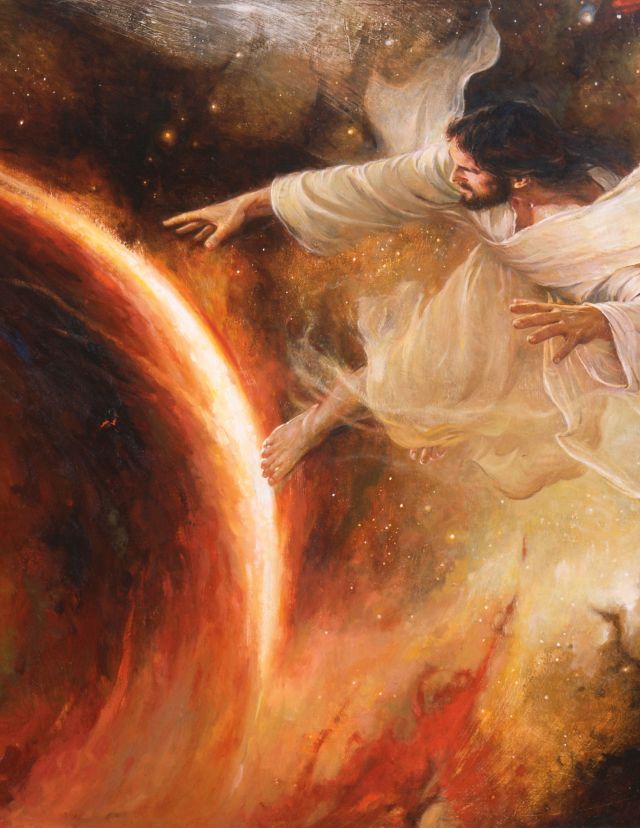
Jesus Christ was “in the beginning with God.”
Joseph Smith Translation, John 1:1–5 ; Jesus Christ Chosen as Savior
Jesus Christ is the “true Light,” the Son of God.
John 1:8–9;verses 1–18; see also Joseph Smith Translation, John 1:1–19
Jesus Christ gives us “power to become” the sons and daughters of God.
what John 1:11–13 teaches about becoming daughters and sons of God. Consider also what these scriptures teach about how we receive this gift: Romans 8:14–18; Mosiah 5:7–9; Doctrine and Covenants 25:1. What does it mean to you to have “power to become” a daughter or son of God?
John 1:18 states that no one has seen God. However, the Joseph Smith Translation of this verse clarifies that “no man hath seen God at any time, except he hath borne record of the Son” (see John 1:18, footnote c). Consider reviewing the following instances in which God the Father was heard bearing record of the Son: Matthew 3:17; 17:5; 3 Nephi 11:6–7; Joseph Smith—History 1:17.
Faithful Resources on the FAIR website:
Faithful Resources on the Church website:
Come, Follow Me—For Individuals and Families
Faithful Resources from other reliable websites:
The Interpreter Foundation
- Come, Follow Me Study and Teaching Helps — Lesson 4: January 16–22, John Claybaugh
- The New Testament in Context: Come, Follow Me Lesson 4
- Audio Roundtable: Come, Follow Me New Testament Lesson 4, We Have Found the Messiah
- Has Anyone Seen God?, Hales Swift
- The Fourth Gospel with Joshua Matson
- Scripture Roundtable: New Testament Gospel Doctrine Lesson 4, “Prepare Ye the Way of the Lord”
BYU Studies/RSC
- John the Beloved, Frank F. Judd Jr.
- John 1, BYU Studies.
Other Helpful Sources
- Come Follow Me – John 1, Book of Mormon Central Archive
- Our Savior in the Gospels: Matthew 3-4 & John 1-2: The Baptism of Jesus
- Mogget’s Musings: Lesson 4 (John 1:35-51) Ben Spackman
- Come, Follow Me – Podcast 4- “We Have Found the Messiah”- John 1, Meridian Magazine
- Come Follow Me 2019: John 1, Book of Mormon Central
Follow Him Dr. Eric Huntsman “We Have Found the Messiah” Part 1 Part 2 Youth
Tyler Griffin & Taylor Halverson John 1 | Jan 16-22 | Come Follow Me Insights
The Scriptures are Real The Divine Christ taught in John 1 with Eric Huntsman; Jewish Daily Life and Messianic Expectations with Trevan Hatch
- Lynne Hilton Wilson
- BibleProject
Faithful Resources Faithful Resources Faithful Resources Faithful Resources Faithful Resources Faithful Resources Faithful Resources Faithful Resources Faithful Resources Faithful Resources Faithful Resources Faithful Resources Faithful Resources Faithful Resources Faithful Resources Faithful Resources Faithful Resources Faithful Resources Faithful Resources Faithful Resources Faithful Resources Faithful Resources Faithful Resources Faithful Resources Faithful Resources Faithful Resources
More about John:
One of the Twelve; son of Zebedee and brother of James. In his early life he was a fisherman in fairly comfortable circumstances (Mark 1:20). We may assume he is the unnamed disciple of the Baptist mentioned in John 1:40. Later on he received a call to be a disciple of Jesus Christ (Matt. 4:21–22; Luke 5:1–11). From Jesus he received the name Boanerges, “a son of thunder” (Mark 3:17). Other incidents that reveal his character are recorded in Mark 9:38; 10:35–40; Luke 9:54.
John’s account does not contain much of the fundamental information that the other records contain, and it is evident that he was writing to members of the Church who already had basic information about the Lord. His primary purpose was to emphasize the divine nature of Jesus as the Only Begotten Son of God in the flesh. (Gospels, Bible Dictionary)
John only: turning water into wine (John 2:1–11); visit of Nicodemus (3:1–10); woman at the well (4:1–42); discourse on bread of life (6:27–71); raising of Lazarus from the dead (11:1–56); washing of feet (13:1–16); discourse about the Holy Ghost (14–16); promise of John’s tarrying on the earth (21:20–24). John’s record is notable for what it does not contain. For example, it has no mention of Jesus’ 40-day experience in the wilderness, of the Mount of Transfiguration, of true parables, and of casting out evil spirits.