FAIR › Scripture Study Resources: Supplement Your Come, Follow Me Study › Study Resources for the Doctrine & Covenants and Church History › Week 12 God Meant It unto Good
Genesis 42-50
Doctrinal Focus
- Key doctrines addressed in this week’s reading
God Can Turn Trials into Blessings
God can take even painful or unfair experiences and work them for our ultimate good.
Joseph reassured his brothers that even though they sold him into slavery, God had sent him ahead to preserve life. His story demonstrates that the Lord can consecrate our trials to bless us and others. (Genesis 45:5–8)
Trials often prepare us for greater responsibility and service.
Joseph’s suffering positioned him to save nations from famine. Similarly, our challenges can refine us and give us empathy and strength to fulfill God’s purposes. (Genesis 50:20)
Forgiveness Brings Peace and Healing
Choosing forgiveness allows us to rise above bitterness and emulate Christ.
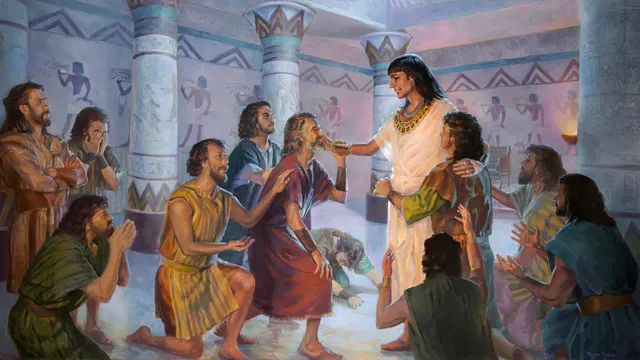
Despite his brothers’ betrayal, Joseph forgave them, wept with them, and provided for them. His mercy reflects Christlike love and demonstrates the peace that forgiveness brings. (Genesis 50:17–21)
Forgiveness restores relationships and strengthens families.
Joseph’s reconciliation with his brothers not only healed past wounds but also secured the survival of their family. Forgiveness today can mend broken trust and unify families. (Genesis 45:14–15)
God Guides His Covenant People through Inspired Direction
God provides guidance through revelation and patriarchal blessings.
- Jacob’s blessings to his sons gave inspired direction for their future and foreshadowed covenant responsibilities. Likewise, patriarchal blessings today offer divine counsel for our lives. (Genesis 49:1, 28)
God fulfills His promises to His covenant people.
- God promised Jacob that He would make of him a great nation in Egypt and bring his posterity back to Canaan. This reminds us that God remembers and fulfills His covenants in His timing. (Genesis 46:3–4)
Historical & Contextual Insights
- Insights in this week’s study
Setting
- The narrative unfolds during a period of severe famine in the ancient Near East, when Egypt’s centralized grain storage system (overseen by Joseph) became a lifeline for surrounding nations (Genesis 41:53–57).
Context
Egypt was one of the few regions with resources to withstand prolonged famine due to Joseph’s inspired preparation. This explains why Jacob’s family journeyed to Egypt seeking food and why Joseph rose to such prominence in Pharaoh’s court.
Significance
- The famine served as the means by which God preserved and relocated Jacob’s family to Egypt, setting the stage for their growth into a nation. This historical moment directly connects to the eventual Exodus and fulfillment of God’s covenant promises.
Takeaway
- God is at work in world events, even crises, aligning them with His greater purposes. When we face uncertainty, we can trust that God may be orchestrating circumstances for future blessings we cannot yet see.
Joseph’s forgiveness was rooted in his understanding of God’s hand in his life.
- Rather than seeking revenge, Joseph reframed his betrayal through a spiritual lens: what his brothers intended for evil, God intended for good (Genesis 50:20). This demonstrates how faith in God’s purposes can transform bitterness into peace.
- Joseph’s perspective highlights the principle of divine providence—God can redirect even harmful human choices to accomplish His will. This helps believers see beyond immediate pain to eternal outcomes.
- Joseph’s mercy also foreshadows the Savior’s role, who forgave those who crucified Him (Luke 23:34). Both examples show that forgiveness is not weakness but spiritual strength grounded in trust in God’s plan.
Jacob’s patriarchal blessings reveal the covenant identity and destiny of Israel’s tribes.
- In Genesis 49, Jacob gathered his sons and pronounced inspired blessings that contained both counsel and prophecy. These blessings were more than fatherly words; they were divine direction shaping the spiritual heritage of Israel.
- The blessings contained symbolic language tied to the tribes’ future roles—Judah’s leadership (Genesis 49:10), Joseph’s fruitfulness (Genesis 49:22–26), and Levi’s priesthood lineage (fulfilled later). This reinforced Israel’s covenantal identity.
- Today, patriarchal blessings serve a similar purpose, offering divine perspective and guidance. They remind modern Saints that they are covenant heirs, with individual roles to fulfill in God’s plan of salvation.
If you have questions on this week’s reading, please email your questions to us here.
Apologetic Application
Criticism 1: “Joseph’s rise to power in Egypt is historically implausible.”
- Claim: “A Hebrew slave could not realistically become second-in-command to Pharaoh.”
- Response:
- Historical Evidence: Ancient Egypt did have high-ranking officials of foreign origin, especially those with specialized skills or wisdom. Records from the Middle Kingdom show viziers and administrators from outside Egypt.
- Eyewitness Support: The biblical narrative reflects Egyptian customs accurately—titles, grain storage, and famine relief systems align with historical patterns, lending credibility to Joseph’s role.
- Spiritual Confirmation: The Spirit confirms that Joseph’s story is more than legend; it reflects God’s ability to raise His servants to positions of influence regardless of their origin.
- Logical Analysis: If Pharaoh saw Joseph’s divine insight as the solution to national survival, it is entirely reasonable that Joseph would be elevated quickly. His promotion fits both the crisis context and God’s providence.
Criticism 2: “The reconciliation between Joseph and his brothers is unrealistic.”
- Claim: “It is unlikely someone would forgive such severe betrayal.”
- Response:
- Historical Evidence: Ancient Near Eastern law often encouraged retribution, which makes Joseph’s forgiveness stand out as radical and consistent with divine inspiration.
- Eyewitness Support: Multiple scriptural witnesses affirm that forgiveness rooted in God’s purposes is both possible and powerful (e.g., Luke 23:34; Mosiah 26:30).
- Spiritual Confirmation: Many modern disciples testify of receiving strength to forgive beyond their natural capacity, aligning with Joseph’s example.
- Logical Analysis: Joseph’s words in Genesis 50:20 show he understood a higher purpose in his suffering. Forgiveness becomes logical when one believes God orchestrates events for good.
Criticism 3: “Jacob’s patriarchal blessings were just poetic farewells.”
- Claim: “They have no real prophetic or spiritual power.”
- Response:
- Historical Evidence: Ancient blessings, especially from patriarchs, often carried legal and prophetic weight, shaping tribal identity for generations. Jacob’s blessings follow that tradition.
- Eyewitness Support: Later scriptures confirm the fulfillment of Jacob’s words—Judah’s leadership (Davidic kingship, messianic prophecy) and Joseph’s fruitfulness in posterity (Ephraim and Manasseh).
- Spiritual Confirmation: Modern patriarchal blessings provide the same inspired guidance, with countless testimonies affirming their divine origin.
- Logical Analysis: It is consistent with God’s covenantal pattern that He would inspire patriarchs to declare prophetic direction to their posterity, rather than leave Israel’s tribes without divine instruction.
Practical Applications
Practical solutions for someone in faith crisis:
Trust God’s hand in trials.
Action Step: Write down one current challenge and prayerfully ask how God might be shaping it for your good.
Why it helps:
Like Joseph, we often don’t see the full picture until much later. Trusting God allows peace to replace fear and helps us endure with faith instead of bitterness.
How to do it:
- – Identify a trial you’re experiencing.
- – Read Genesis 50:20 and reflect on Joseph’s perspective.
- – Pray specifically to see God’s hand in your situation
- – Record impressions or insights in a journal.
Encouraging Thought:
Ye shall have joy in your trials, and your faith shall be strengthened.
Choose forgiveness over resentment.
Action Step: Reach out to someone with whom you’ve had tension and offer a gesture of kindness.
Why it helps:
Forgiveness frees the heart from the heavy weight of anger. Like Joseph with his brothers, choosing mercy allows God’s love to heal relationships and bring peace.
How to do it:
- – Think of someone you need to forgive.
- – Pray for strength to see them as God sees them.
- – Take one small action of kindness (message, service, prayer).
- – Repeat consistently until bitterness gives way to peace.
Encouraging Thought:
Without forgiveness, there is no real future.
Seek guidance through patriarchal blessings.
- Action Step: If you have received a patriarchal blessing, reread it and note counsel that applies to your current life stage. If not, prayerfully consider preparing to receive one.
Why it helps:
Patriarchal blessings, like Jacob’s words to his sons, provide inspired direction and confirm God’s promises. They help us align our choices with His eternal plan.
How to do it:
- – Read your patriarchal blessing prayerfully.
- – Highlight phrases that stand out to you.
- – Identify one way to act on its counsel this week.
- – Record how applying it affects your spiritual growth.
Encouraging Thought:
- Your patriarchal blessing will see you through the darkest night.
Ideas for Teaching
God Turns Trials into Blessings
Objective: Help learners see how God can transform challenges into opportunities for growth.
Materials Needed:
Paper, pens/pencils, small stones (optional).
Activity Steps:
Activity Steps:
- Introduction (5 min): Give each person a small stone and ask them to write on paper a “burden” or trial they are currently carrying.
- Scripture Discussion (5 min): Read Genesis 50:20 and discuss how Joseph reframed betrayal and suffering as part of God’s plan for good.
- Application (5 min): Invite learners to consider how their current burdens might prepare them for future blessings. Have them symbolically “set down” the stone as an act of trust in God.
Follow-Up Question: What helps you trust that God is working for your good, even when you can’t yet see the outcome?
The Power of Forgiveness
Objective: Encourage learners to choose forgiveness as Joseph did with his brothers.
Materials Needed:
Whiteboard/marker or slips of paper and pens.
Activity Steps:
Activity Steps:
Introduction (5 min): Ask learners to list (privately or aloud) situations where forgiveness might be difficult.
Scripture Discussion (5 min): Read Genesis 45:4–8 and discuss Joseph’s perspective on his brothers’ betrayal. Highlight how forgiveness was possible because he trusted God’s plan.
Application (5 min): Invite learners to write a step they can take toward forgiveness (prayer, act of kindness, letting go of resentment). They can keep it private or share.
Follow-Up Question: What blessings have you experienced when you chose to forgive rather than hold on to hurt?
Patriarchal Blessings—Modern Guidance from God
Objective: Teach learners to value patriarchal blessings as modern parallels to Jacob’s blessings to his sons.
Materials Needed:
Copies of Jacob’s blessings in Genesis 49, and optional quotes from Church leaders on patriarchal blessings.
Activity Steps:
Activity Steps:
Introduction (5 min): Share how Jacob blessed his children with inspired promises and counsel. Ask learners if they’ve seen how blessings can guide life.
Scripture Discussion (5 min): Read selected verses from Genesis 49 and compare them to the role of patriarchal blessings today. Discuss why God gives such individualized counsel.
Application (5 min): Encourage learners to review their patriarchal blessing (or prepare to receive one) and prayerfully identify one piece of counsel to apply this week.
Follow-Up Question: How can your patriarchal blessing (or Jacob’s example) help you face present challenges with faith and direction?
QUICK REFERENCE
Key Points
- God can turn trials and injustices into blessings for His greater purposes (Genesis 50:20).
- Forgiveness brings healing and allows God’s plan to unfold (Genesis 45:4–8).
- Patriarchal blessings today function like Jacob’s blessings, offering inspired counsel and covenant direction (Genesis 49).
- Trust in God’s providence helps us endure with faith, even when outcomes are uncertain.
Core Apologetic Answers
- Why trust modern prophets?
- Modern prophets provide inspired guidance, just as Joseph did in ancient Egypt. Their counsel is consistent with scripture and confirmed by the Spirit. Prophets do not replace God but help His children apply eternal truths to modern challenges.
- Why does God allow mistakes?
- God permits human agency, which includes mistakes and even betrayal, but He weaves those actions into His greater plan. Joseph’s suffering in Egypt was not caused by God but was transformed by Him into deliverance for Israel. Likewise, God allows growth through challenges while ensuring His eternal promises are fulfilled.
- God permits human agency, which includes mistakes and even betrayal, but He weaves those actions into His greater plan. Joseph’s suffering in Egypt was not caused by God but was transformed by Him into deliverance for Israel. Likewise, God allows growth through challenges while ensuring His eternal promises are fulfilled.
Key Resources
Scriptures
- Genesis 50:20 — “Ye thought evil against me; but God meant it unto good.”
- Doctrine and Covenants 24:8 — “Be patient in afflictions, for thou shalt have many.”
Church Documents
- True to the Faith (Forgiveness, Agency, Patriarchal Blessings).
The Living Christ: The Testimony of the Apostles (prophetic witness of Christ’s role in guiding His people).
Online Resources
- Patriarchal Blessings (Gospel Topics)
- Forgiveness (Gospel Topics)