FAIR › Scripture Study Resources: Supplement Your Come, Follow Me Study › Study Resources for the Doctrine & Covenants and Church History › Week 40 It Is Thy House, a Place of Thy Holiness
DOCTRINE AND COVENANTS 109-110
Doctrinal Focus
- Key doctrines addressed in this week’s reading
The House of the Lord is a place of holiness and peace.
The temple is the Lord’s house, a sacred space dedicated to His glory and worship.
- In Doctrine and Covenants 109:8, the Lord commands, “Organize yourselves; prepare every needful thing; and establish a house, even a house of prayer, a house of fasting, a house of faith, a house of learning…” This teaches that temples are not casual spaces; they are carefully prepared environments that reflect the sacredness of our covenants with God.
We are blessed with protection, peace, and revelation when we attend the temple.
Doctrine and Covenants 109:22 promises that those who enter the temple worthily shall feel thy power, and shall see eye to eye, and shall confess that God is with thee. The temple becomes a refuge from worldly confusion, a place where our spiritual vision is clarified, and our relationship with God is strengthened.
Priesthood keys were restored to prepare the world for the Second Coming.
Christ and other heavenly messengers restored essential priesthood keys in the Kirtland Temple.
In Doctrine and Covenants 110:11–16, Moses, Elias, and Elijah each appeared to confer specific keys: gathering Israel, the gospel of Abraham, and the sealing power. This moment marked the Lord’s direct preparation of His people for the last days and emphasized the importance of temple work in hastening His coming.
The restoration of priesthood keys empowers the Church to perform sacred ordinances on earth and in the temple.
Without these keys, the Church could not administer saving ordinances like baptism, temple sealings, or the gathering of Israel. Doctrine and Covenants 110 highlights that God’s authority is crucial for His work to progress and for families to be bound eternally.
The Lord hears and answers our dedicated prayers, especially those offered in His holy house.
The dedicatory prayer of the Kirtland Temple teaches that sincere, collective prayer can bring the power of God among His people.
- Doctrine and Covenants 109:1–80 is a moving, powerful prayer by Joseph Smith, asking for forgiveness, blessings, and divine protection. The prayer shows that when we approach God with real intent, especially in sacred settings, He hears and answers our pleas.
Temples are sanctified places where heaven and earth meet in answer to faithful prayer.
In response to the dedication and prayers offered at Kirtland, the Savior Himself appeared (D&C 110:2–10). This divine visit shows that temples are places where God’s presence is especially close, offering us access to personal revelation and peace beyond this world.
Historical & Contextual Insights
- Insights in this week’s study
Setting
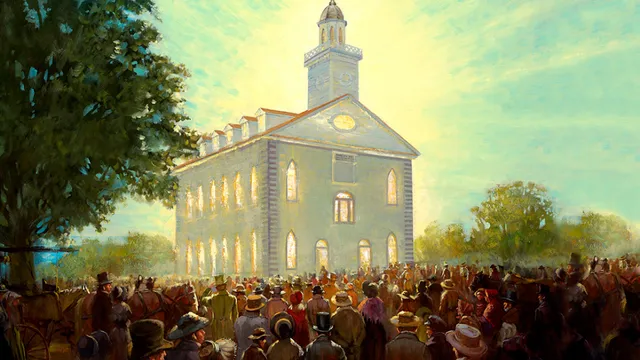
- In the early months of 1836, after years of sacrifice, the Saints completed construction of the Kirtland Temple—the first temple built in this dispensation.
Context
- The Kirtland Temple dedication took place on March 27, 1836. This event followed a period of extreme hardship, financial sacrifice, and collective effort among the Saints. Joseph Smith prepared a dedicatory prayer by revelation (D&C 109). One week later, on April 3, 1836, the Savior appeared to Joseph Smith and Oliver Cowdery in the temple, followed by Moses, Elias, and Elijah, each restoring crucial priesthood keys (D&C 110).
Significance
- The dedication and subsequent visions in the Kirtland Temple symbolized a spiritual high point for the early Saints. The restoration of priesthood keys ensured the authority necessary for temple ordinances, missionary work, and the sealing of families, anchoring the work of salvation for generations.
Takeaway
- Understanding this history reminds us that God’s greatest blessings often come after sacrifice and dedication. Our modern temples continue the pattern established at Kirtland, and we receive similar promises of protection, revelation, and peace as we honor sacred covenants today.
The Kirtland Temple was not used for ordinances like modern temples but served as a sacred place for instruction, endowment of spiritual power, and worship.
- Unlike today’s temples where baptisms for the dead, endowments, and sealings are performed, the Kirtland Temple was mainly used for meetings, instruction, and spiritual endowments. Doctrine and Covenants 109 reflects the Saints’ plea for protection and empowerment as they faced mounting persecution and prepared to spread the restored gospel.
- Joseph Smith taught that the Saints were to be “endowed with power from on high” in the temple (see D&C 38:32), referring to spiritual gifts and revelation rather than today’s full temple ordinances.
- This context shows that temples are adaptable to the Lord’s unfolding work. The Lord gradually introduced ordinances as His people were ready, demonstrating His pattern of teaching “line upon line, precept upon precept” (2 Nephi 28:30).
The appearance of Moses, Elias, and Elijah in D&C 110 fulfilled ancient prophecies and prepared the Saints for worldwide missionary and temple work.
- Each visitor restored specific priesthood keys with critical roles in the Lord’s latter-day work. Moses restored the keys for the gathering of Israel, Elias brought the keys for the gospel of Abraham (focusing on eternal families and celestial glory), and Elijah restored the sealing power necessary for temple ordinances like eternal marriage and family sealing.
- These visitations fulfill Malachi’s prophecy that Elijah would return “before the coming of the great and dreadful day of the Lord” (Malachi 4:5–6), connecting hearts across generations.
- Understanding this context enriches our view of the temple as not just a place of individual salvation, but as a center for the salvation of families and the gathering of all God’s children throughout the earth.
If you have questions on this week’s reading, please email your questions to us here.
Apologetic Application
Criticism 1: "The visions in the Kirtland Temple were hallucinations or emotionally driven experiences."
- Claim: “Joseph Smith and Oliver Cowdery imagined or fabricated the temple visions to maintain their authority.”
- Response:
- Historical Evidence: The visions were recorded immediately after the experiences and circulated among Church members, consistent with Joseph’s pattern of documenting significant revelations.
- Eyewitness Support: Joseph Smith and Oliver Cowdery, two independent witnesses, both testified to the divine appearances with consistent detail, strengthening the credibility of their accounts.
- Spiritual Confirmation: Many Saints at the Kirtland Temple dedication felt a powerful outpouring of the Spirit, reporting a “heavenly choir” and manifestations consistent with D&C 110.
- Logical Analysis: Given the extreme persecution Joseph and Oliver faced, fabricating such claims would have only increased opposition; their willingness to stand by their testimony suggests sincerity over deception.
Criticism 2: "The Kirtland Temple was unnecessary because Christ fulfilled the law of temples."
- Claim: “New temples after Christ are not scripturally supported.”
- Response:
- Historical Evidence: In the New Testament, Christ honored the temple (Luke 2:46; John 2:16) and prophesied of future temple-related fulfillment (Matthew 24:15).
- Eyewitness Support: The divine acceptance of the Kirtland Temple is evidenced by Christ’s personal appearance and the restoration of essential priesthood keys, as recorded by firsthand witnesses.
- Spiritual Confirmation: Modern members testify of the Spirit felt in temples today, fulfilling prophecy about the Lord’s house being “a house of prayer” (D&C 109:8).
- Logical Analysis: If Christ’s mission fulfilled temple worship entirely, no temple would have been prophesied in the future (see Ezekiel 47 or Revelation 21); thus, Latter-day temples fit scriptural expectations.
Criticism 3: "The restoration of priesthood keys was a made-up claim to give Joseph more power."
- Claim: “Joseph Smith fabricated the story of Moses, Elias, and Elijah appearing to him.”
- Response:
- Historical Evidence: The concept of priesthood keys was not invented by Joseph; it mirrors biblical authority structures (Matthew 16:19) and was articulated early in Church teachings before the Kirtland vision.
- Eyewitness Support: Oliver Cowdery was present and confirmed the visions and the restoration of keys, providing corroborating testimony alongside Joseph’s.
- Spiritual Confirmation: Members experience the blessings of these restored keys today through ordinances like temple sealings and missionary work—fruits verifying the roots.
- Logical Analysis: Power-hungry leaders typically consolidate control; instead, priesthood keys were distributed widely among leaders, suggesting divine governance rather than personal ambition.
Practical Applications
Practical solutions for someone in faith crisis:
Find refuge and strength by attending the temple regularly.
Action Step: Set a goal to attend the temple (or do family history work if a temple isn’t nearby) at least once a month.
Why it helps:
The Lord promises that the temple will be “a place of thanksgiving” and a shield against the storms of life (D&C 109:21, 25–26). Regular temple worship renews our spiritual strength and invites personal revelation.
How to do it:
- – Look up your local temple’s schedule or find ways to prepare names for temple ordinances.
- – Set a specific date and time on your calendar for temple attendance or family history work.
- – Prepare spiritually by pondering a question or burden you can bring to the Lord.
- – Attend with a prayerful heart, expecting to feel peace and direction.
- – Record impressions afterward in a journal.
Encouraging Thought:
Wherever the Saints gather and the temple spirit is present, there the house of the Lord will be
Seek and sustain priesthood keys and authority in your life.
Action Step: Recognize and support those who hold priesthood keys in your ward, stake, and family.
Why it helps:
Priesthood keys ensure that God’s work is done His way. Honoring those keys opens the door to receiving inspired guidance, personal blessings, and protection from deception.
How to do it:
- – Learn who holds priesthood keys that affect your life (bishop, stake president, quorum leaders, etc.).
- – Pray for these leaders by name, asking the Lord to bless and guide them.
- – Listen carefully when they speak, seeking personal application from their counsel.
- – Offer to serve when opportunities arise, sustaining them by your actions.
Encouraging Thought:
- When we sustain our leaders, we are not merely showing loyalty to a person; we are showing loyalty to the Lord.
Turn to collective prayer for greater spiritual power.
- Action Step: Organize or participate in a group prayer experience (family, quorum, class) focused on a common righteous desire.
Why it helps:
Doctrine and Covenants 109 shows the power of unified prayer: the Saints prayed together for protection and blessings, and the Lord responded miraculously. United prayer amplifies faith and invites the Spirit more powerfully.
How to do it:
- – Choose a purpose for collective prayer (e.g., missionary work, temple attendance, healing, guidance).
- – Invite family members, friends, or Church groups to join in a time of prayer.
- – Prepare by fasting if appropriate to increase spiritual sensitivity.
- – Pray together, allowing each person to contribute if they feel prompted.
- – Follow up by acting in faith on any impressions received.
Encouraging Thought:
“Where two or three are gathered together in my name, there am I in the midst of them.” — Matthew 18:20
Ideas for Teaching
Building Our Sacred Space
Objective: Help learners understand the importance of preparing their lives as places where the Spirit can dwell, like the temple.
Materials Needed:
Blank paper, pencils, markers, list of temple attributes from D&C 109:8.
Activity Steps:
Activity Steps:
- Introduction (5 min): Ask learners: “If you were building a perfect house for God, what would you include?” Let them brainstorm quickly.
- Scripture Discussion (5 min): Read Doctrine and Covenants 109:8. Discuss what “a house of prayer, fasting, faith, learning, glory, order, God” might look like in a temple and in our lives.
- Application (5 min): Have learners draw a “house” and label it with spiritual attributes they want in their lives (e.g., “prayer room” = daily prayer, “study hall” = scripture study).
Follow-Up Question: What is one thing you could ‘build’ into your daily life this week to invite God’s Spirit more fully?
Keys to the Kingdom
Objective: Teach about the restoration of priesthood keys and their importance today.
Materials Needed:
Paper keys cutouts, pens, chalkboard or whiteboard.
Activity Steps:
Activity Steps:
Introduction (5 min): Show a key and ask: “What important things can you open with a key?” (Home, car, safes, etc.). Connect this to spiritual “keys.”
Scripture Discussion (5 min): Read D&C 110:11–16. Explain briefly what Moses, Elias, and Elijah restored. Write the words “Gathering,” “Gospel of Abraham,” and “Sealing” on the board.
Application (5 min): Give each learner a paper key. Ask them to write on it one “door” in their life they want priesthood power to help them open (e.g., better family relationships, stronger faith).
Follow-Up Question: How have priesthood keys already blessed your life, even if you didn’t realize it before?
Power in Unified Prayer
Objective: Show how unified prayer can bring greater power and peace into our lives, like at the Kirtland Temple dedication.
Materials Needed:
A printed or displayed excerpt from Doctrine and Covenants 109:22–26, small slips of paper, a container.
Activity Steps:
Activity Steps:
Introduction (5 min): Ask: “Have you ever prayed with a group for something important? How did it feel different than praying alone?”
Scripture Discussion (5 min): Read D&C 109:22–26. Highlight how the Saints prayed together for divine protection and spiritual power, and how the Lord promised blessings.
Application (5 min): Have each learner write a righteous desire on a slip of paper (e.g., strength, guidance, peace). Place them all in a container, then offer a group prayer, asking the Lord to help with the desires collectively.
Follow-Up Question: What does praying together teach us about the kind of community God wants us to build?
QUICK REFERENCE
Key Points
- The temple is the Lord’s house, a place of holiness, peace, and personal revelation (D&C 109:8, 109:22).
- Priesthood keys necessary for the gathering of Israel and temple work were restored in the Kirtland Temple (D&C 110:11–16).
- Unified prayer and sacrifice prepare the way for divine manifestations and blessings (D&C 109:1–80).
- God’s pattern is to reveal truth and priesthood authority “line upon line” as His people are ready (D&C 98:12).
Core Apologetic Answers
- Why trust modern prophets?
- Modern prophets, like Joseph Smith, follow a biblical pattern of divine calling and revelation. Their testimonies are confirmed by the fruits of their work (Matthew 7:20), the outpouring of the Spirit (John 16:13), and fulfilled prophecies (Amos 3:7).
- Why does God allow mistakes?
- God works through imperfect people to accomplish His perfect purposes. Just as ancient prophets had weaknesses (e.g., Moses, Peter), modern prophets grow and learn over time. This process demonstrates God’s mercy and humanity’s role in divine work (Ether 12:27).
Key Resources
Scriptures
- Doctrine and Covenants 109 (Dedicatory prayer of the Kirtland Temple)
- Doctrine and Covenants 110 (Restoration of priesthood keys)
- Doctrine and Covenants 109 (Dedicatory prayer of the Kirtland Temple)
Church Documents
- The Living Christ: The Testimony of the Apostles (modern prophetic testimony of Jesus Christ)
The Family: A Proclamation to the World (priesthood keys and temple work in family life)
- The Living Christ: The Testimony of the Apostles (modern prophetic testimony of Jesus Christ)
Online Resources
- Come, Follow Me—Doctrine and Covenants (Official Church study manual)
- Topics and Questions: Priesthood and Revelation (Gospel Topics Essay on Priesthood)